Question
The surface area of a sphere is $2464cm^2$​​​​​​​ lf its radius be doubled, what will be the surface area of the new sphere?

Answer

Let the original radius be r.
⇒ original surface area $=4\pi\text{r}^2=2464\text{cm}^2\ ...(1)$
Given new radius $=2\text{r}$
⇒ New surface area $4\pi(2\text{r})^2$
$=4\times4\pi\text{r}^2$
$=4\times2464\ ...(\text{From}(1))$
$=9856\text{cm}^2$

Need a full question paper?

Generate a complete, print-ready paper with questions like this in minutes — across 16+ boards, with answer keys.
Start Generating Free

Similar questions

Which term of $A.P. 3,15,27,39, \ldots \ldots$ will be $132$ more than its $54^{\text {th }}$ term.
Which point on y-axis is equidistant from $(2, 3)$ and $(-4, 1)?$
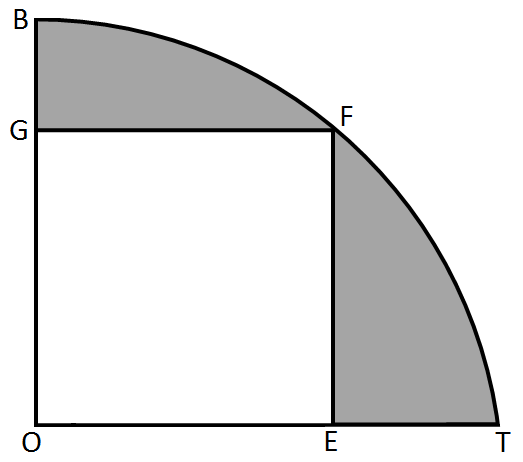
In the following figure, $O E=20 cm$. In sector $O S F T$, square $O E F G$ is inscribed. Find the area of the shaded region.
A tent is in the form of a right circular cylinder surmounted by a cone. The diameter of the base of the cylinder or the cone is $24\ m$. The height of the cylinder is $11\ m$. If the vertex of the cone is 16m above the ground, find the area of the canvas required for making the tent. $(\text{Use}\ \pi=\frac{22}{7})$
Find the sum of the following arithmetic series:
$5 + (-41) + 9 + (-39) + 13 + (-37) + 17 + ..... + (-5) + 81 + (-3).$
The product of Shikha's age five years ago and her age $8$ years later is $30$, her age at both times being given in years. Find her present age.
Two poles of heights $25 \ m$ and $35 \ m$ stand vertically on the ground. The tops of two poles are connected by a wire, which is inclined to the horizontal at an angle of $30^{\circ}$. Find the length of the wire and the distance between the poles.
Find the value of a and b for which the following systems of linear equations has an infinite number of solutions:
$2x + 3y = 7,$
$(a + b)x + (2a - b)y = 21$
If $\tan\theta=\frac{\text{a}}{\text{b}},$ prove that $\frac{\text{a}\sin\theta+\text{b}\cos\theta}{\text{a}\sin\theta+\text{b}\cos\theta}=\frac{\text{a}^2-\text{b}^2}{\text{a}^2+\text{b}^2}.$
Find the roots of the following quadratic equations by the factorisation method:
$2\text{x}^2+\frac{5}{3}\text{x}-2=0.$