MCQ
The surface tension of a liquid at its boiling point
  • Becomes zero
  • B
    Becomes infinity
  • C
    is equal to the value at room temperature
  • D
    is half to the value at the room temperature

Answer

Correct option: A.
Becomes zero
a
(a) As the temperature increases, surface tension decreases. At the boiling point, every molecule of a liquid are in motion from bottom to surface, and due to rise in temperature, molecules lose the adhesion and hence, surface tension becomes zero.

Need a full question paper?

Generate a complete, print-ready paper with questions like this in minutes — across 16+ boards, with answer keys.
Start Generating Free

Similar questions

In a npn transistor $10^{10}$ electrons enter the emitter in $10^{-6}\; s $. 4% of the electrons are lost in the base. The current transfer ratio will be
Intensity of $X-$ rays depends upon the number of
If an electron moves from rest from a point at which potential is $50\, volt$ to another point at which potential is $70\, volt$, then its kinetic energy in the final state will be
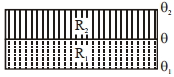
The temperature $\theta$ at the junction of two insulating sheets, having thermal resistances $R _{1}$ and $R _{2}$ as well as top and bottom temperatures $\theta_{1}$ and $\theta_{2}$ (as shown in figure) is given by
A circular disc of radius $R$ carries surface charge density $\sigma(r)=\sigma_0\left(1-\frac{r}{R}\right)$, where $\sigma_0$ is a constant and $r$ is the distance from the center of the disc. Electric flux through a large spherical surface that encloses the charged disc completely is $\phi_0$. Electric flux through another spherical surface of radius $\frac{R}{4}$ and concentric with the disc is $\phi$. Then the ratio $\frac{\phi_0}{\phi}$ is. . . . . .
A simple harmonic wave having an amplitude a and time period $T$ is represented by the equation $y = 5\sin \pi (t + 4)m.$ Then the value of amplitude $(a)$ in $(m)$ and time period $(T) $ in second are
The $S.I.$ unit of radioactivity is
Primary side of a transformer is connected to $230 V, 50 Hz$ supply. Turns ratio of primary to secondary winding is $10: 1$. Load resistance connected to secondary side is $46 \Omega$. The power consumed in it is :
An iron rod of length $2m$ and cross section area of $50\,m{m^2}$, stretched by $0.5\, mm$, when a mass of $250\, kg$ is hung from its lower end. Young's modulus of the iron rod is
The length of the tube of a microscope is $10\, cm$. The focal lengths of the objective and eye lenses are $0.5\, cm$ and $1.0 \,cm$. The magnifying power of the microscope is about