MCQ
The surface tension of a liquid at its boiling point
  • Becomes zero
  • B
    Becomes infinity
  • C
    is equal to the value at room temperature
  • D
    is half to the value at the room temperature

Answer

Correct option: A.
Becomes zero
a
(a) As the temperature increases, surface tension decreases. At the boiling point, every molecule of a liquid are in motion from bottom to surface, and due to rise in temperature, molecules lose the adhesion and hence, surface tension becomes zero.

Need a full question paper?

Generate a complete, print-ready paper with questions like this in minutes — across 16+ boards, with answer keys.
Start Generating Free

Similar questions

forceA particle moves with constant speed $v$ along a circular path of radius $r$ and completes the circle in time $T$. The acceleration of the particle is
A uniform spherical shell gradually shrinks maintaining its shape. The gravitational potential at the centre:
  1. Increases.
  2. Decreases.
  3. Remains constant.
  4. Oscillates.
A student plotted the following four graphs representing the variation of velocity of sound in a gas with the pressure p at constant temperature. Which one is correct?
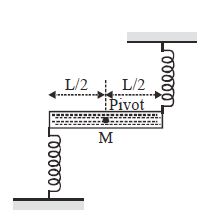
A uniform stick of mass $M$ and length $L$ is pivoted at its centre. Its ends are tied to two springs each of force constant $K$ . In the position shown in figure, the strings are in their natural length. When the stick is displaced through a small angle $\theta $ and released. The stick
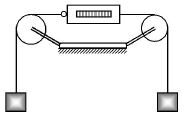
In the arrangement shown, the pulleys are fixed and ideal, the strings are light, $m_1 > m_2$ and $S$ is a spring balance which is itself massless. The reading of $S$ (in units of mass) is
In case of a freely falling body, the ratio of kinetic energy at the end of the third second increase in kinetic energy in the next three seconds is:
The tension of a stretched string is increased by $69\%$. In order to keep its frequency of vibration constant, its length must be increased by .... $\%$
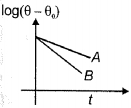
Two bodies $A$ and $B$ of equal masses, area and emissivity cooling under Newton's law of cooling from same temperature are represented by the graph. If $\theta$ is the instantaneous temperature of the body and $\theta_0$ is the temperature of surroundings, then relationship between their specific heats is ..........
Four mole of hydrogen, two mole of helium and one mole of water vapour form an ideal gas mixture. What is the molar specific heat at constant pressure of mixture?
A particle is projected from horizontal making an angle of $53^{\circ}$ with initial velocity $100\,m / s$. The time taken by the particle to make angle $45^{\circ}$ from horizontal is $.........\,s$