MCQ
The symbol given in figure represents
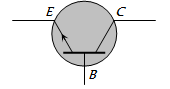
  • $\text{NPN}$ transistor
  • B
    $\text{PNP}$ transistor
  • C
    Forward biased $\text{PN}$ junction diode
  • D
    Reverse biased $\text{NP}$ junction diode

Answer

Correct option: A.
$\text{NPN}$ transistor

Need a full question paper?

Generate a complete, print-ready paper with questions like this in minutes — across 16+ boards, with answer keys.

Start Generating Free

Similar questions

Equivalent energy of mass equal to 1 a.m.u. is(a) 931 KeV(b) 931 eV(c) 931 MeV(d) 9.31 MeV
       
Energy of the electron in $n^{th}$ orbit of hydrogen atom is given by $E_n=-\frac{13.6}{n^2}\ eV$. The amount of energy needed to transfer electron from first orbit to third orbit is
Newton postulated his corpuscular theory of light on the basis of:
$X-$rays of wavelength $0.1 \mathring A$ allowed to fall on a metal get scattered. The wavelength of scattered radiation is $0.111 \mathring A $. If $h = 6.624 \times 10^{–34}\ J-s$ and $m_0 = 9 \times 10^{–31}\ kg,$ then the direction of the scattered photons will be
A ball of mass $1 g$ and charge $10^{-8} C$ moves from a point $A.$ where potential is $600$ volt to the point $B$ where potential is zero. Velocity of the ball at the point B is $20 \ cm / s$. The velocity of the ball at the point $A$ will be
When wavelength of incident photon is decreased then(a) Velocity of emitted photo-electron decreases(b) Velocity of emitted photoelectron increases(c) Velocity of photoelectron do not charge(d) Photo electric current increases


The charge on a particle $Y$ is double the charge on particle $X.$ These two particles $X$ and $Y$ after being accelerated through the same potential difference enter a region of uniform magnetic field and describe circular paths of radii $R_1$  and $R_2$ respectively. The ratio of the mass of $X$ to that of $Y$ is
A bi-convex lens made of glass (refractive index 1.5) is put in a liquid of refractive index 1.7. Its focal length will(a) Decrease and change sign(b) Increase and change sign(c) Decrease and remain of the same sign(d) Increase and remain of the same sign


A liquid can easily change its shape but a solid can not because.
  1. The density of a liquid is smaller than that of a solid.
  2. The forces between the molecules is stronger in solid than in liquids.
  3. The atoms combine to form bigger molecules in a solid.
  4. The average separation between the molecules is larger in solids.
If in Rutherford’s experiment, the number of particles scattered at 90° angle are 28 per min, then number of scattered particles at an angle 60°  and 120°  will be (a) 112/min, 12.5/min(b) 100/min, 200/min(c) 50/min, 12.5/min(d) 117/min, 25/min