Question
The table shows four different materials and their resistivity.

Material

Resistivity(Ω m)

Material 1

1.62 ×10⁻⁸

Material 2

100 ×10-6

Material 3

6.84 ×10⁻⁸

Material 4

44 ×10-6

1. Which material is the best conductor of electricity?
A. Material 1
B. Material 2
C. Material 3
D. Material 4
2. What is the SI unit of Resistivity?
3. Why is nichrome wire used in many electrical heating devices?
A. It has low resistivity and low melting point.
B. It has high resistivity and low melting point.
C. It has low resistivity and high melting point.
D. It has high resistivity and high melting point.
Answer

1. A. Material 1
2. Mentions ohm-meter (Ω m) as correct response.
3. D. It has high resistivity and high melting point.
Need a full question paper?

Generate a complete, print-ready paper with questions like this in minutes — across 16+ boards, with answer keys.

Start Generating Free

Similar questions

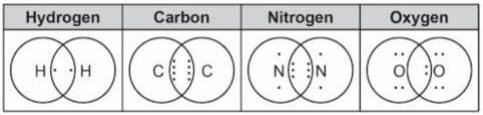
The pictures show the bonds formed by the sharing of electrons by the atoms of four different
molecules.

Image
1. Which molecule has the strongest bond between its atoms?
A. Hydrogen
B. Carbon
C. Nitrogen
D. Oxygen
2. What is this type of bond between atoms known as?
3. Which of these is another way of representing the bonds between the atoms of a nitrogen molecule?
A. $N 0 N$
C. $N \equiv N$
B. $N \times N$
D. $N - N$
4. Which of these statements is true about carbon compounds?
Circle ‘Yes’ or ‘No’ for the correct response.

Is this true about carbon compounds?

Yes or No

They are good conductors of electricity.

Yes/No

They exist in either saturated or unsaturated form

Yes/No

They have lower boiling points than ionic compounds.

Yes/No

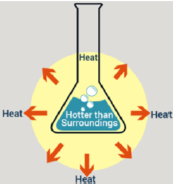
The dissolving of an acid or a base in water is a highly exothermic reaction. Care must be taken while mixing concentrated nitric acid or sulphuric acid with water. The acid must always be added slowly to water with constant stirring. If water is added to a concentrated acid, the heat generated may cause the mixture to splash out and cause burns. The glass container may also break due to excessive local heating. Look out for the warning sign on the can of concentrated sulphuric acid and on the bottle of sodium hydroxide pellets.
Image

(a) What is the exothermic reaction?
(b) Write an example of an exothermic reaction.
OR
How will you obtain sulphuric acid from an acidic oxide?
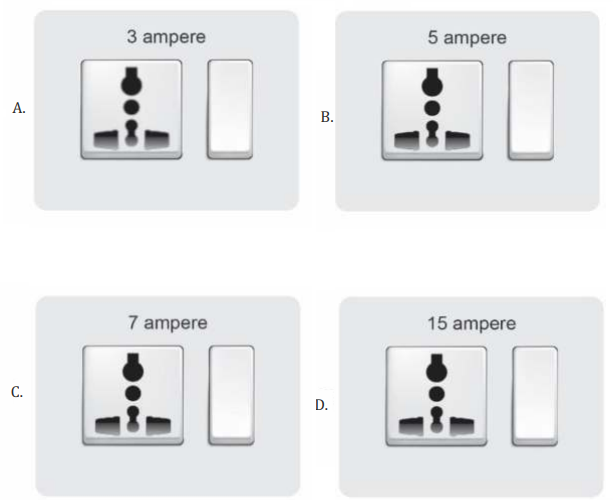
Electrical devices often have an ampere marking to indicate the strength of electric current
required for it to work.
10. Will there be any change in the ammeter reading if the length of the wire in the circuit is doubled?
Explain your answer.

Image

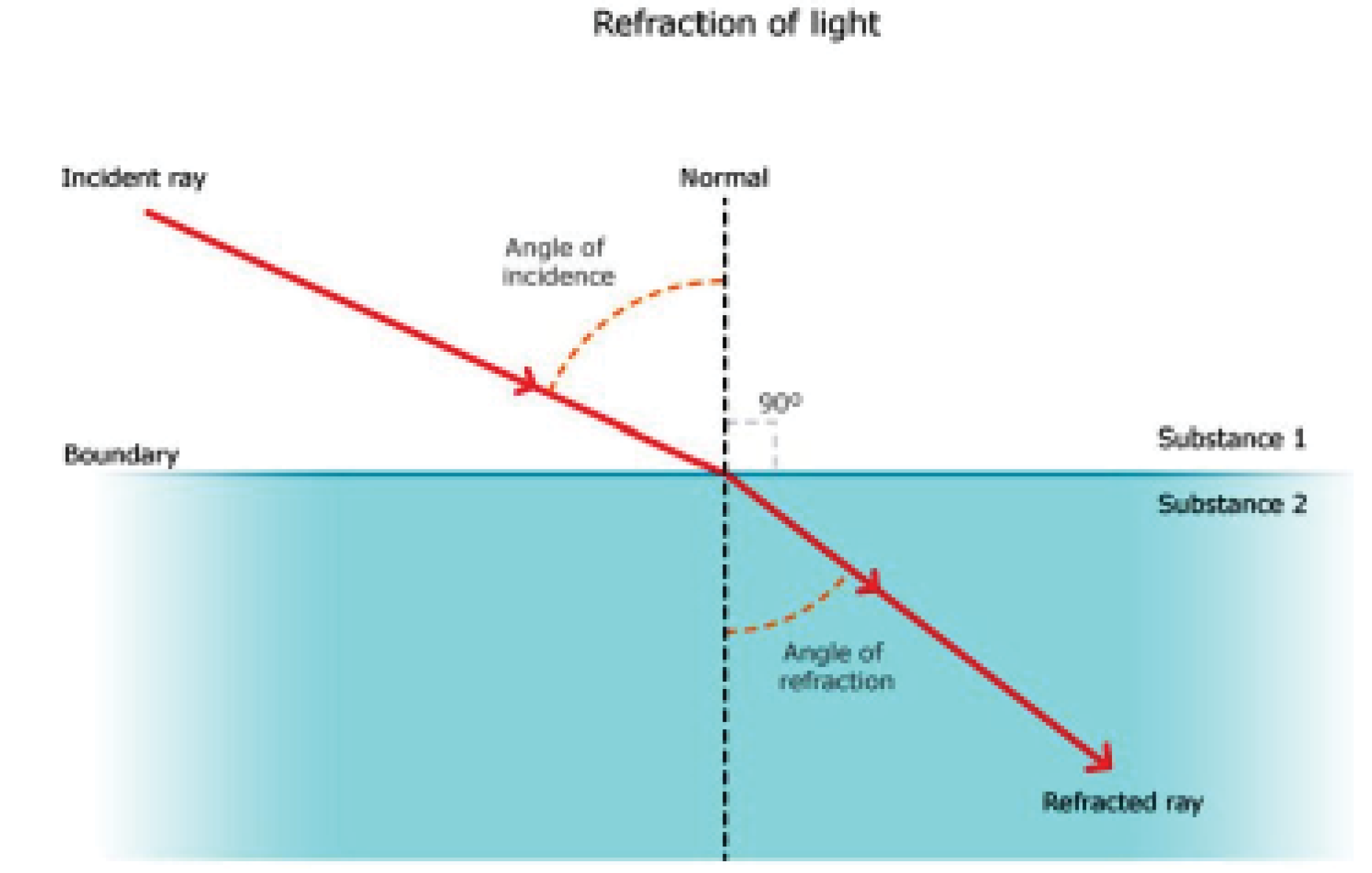
"Change in path of a light ray as it passes from one medium to another medium is called refraction of light."

When light travels from a rarer medium to a denser one, it bends towards the normal $(i>r)$ and when travels from a denser medium to a rarer one. it bends away from the normal $(i<r)$.
Where, $\quad i=$ Angle of incidence
and $\quad r=$ Angle of refraction
We can see refraction in our daily life, some of the examples are given below :
The bottom of a tank or pond containing water appears to be raised due to refraction of light which takes place when light rays pass from the pool of water into the air. The letters appear to be raised when viewed through a glass slab placed over the document because of refraction of light.
When a light ray enters in a glass slab, then the emergent ray is parallel to the incident ray but it is shifted sideward slightly.
In this case, refraction takes place twice, first when ray enters glass slab from air and second when exits from glass slab to air.
(i) What do you mean by optically rarer and denser medium ?
(ii) What is the cause of refraction?
(iii) Draw a ray diagram shotving refraction through a glass slab.
or
(iv) Give one example of refraction from our daily life experience other than the two examples given above.

Nastic movements in plants are not directional movements. They are not dependent on the stimulus and are growth independent. For example, the leaves of a touch me not plant (Mimosa pudica), fold up immediately when touched. These kinds of changes occur due to the changes in the amount of water in the leaves. Depending on the quantity, they either swell up or shrink. Plant hormones or phytohormones are responsible for the control and coordination of plants. There are different types of hormones, which affect the growth of a plant. Phytohormones are chemical compounds which are released by stimulated cells. These hormones are diffused around the plant cells. They have a role in the cell division, cell enlargement, cell differentiation, fruit growth, falling of leaves, ripening of fruits, ageing of plants etc.
(i) Name the phenomenon called for the movement in growth of plants.
(ii) What do you mean by nastic movement?
(iii) What are the different types of harmonies of plants?
or
(iv) The plant harmone help in the cell growth at the shoot tips by elongating the cells and help in the growth process is :
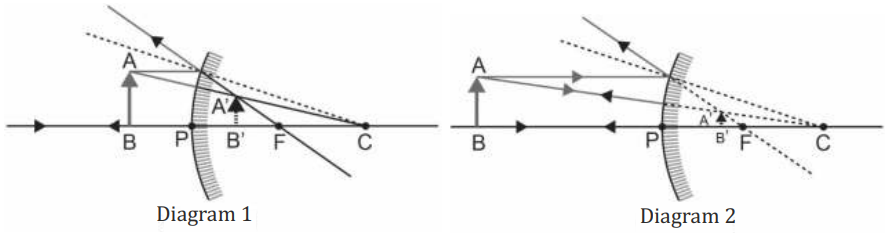
The pictures show the ray diagrams of images formed by convex mirrors.
P is the pole or centre of the relecting surface of the mirror.
C is the centre of curvature of the mirror.
F is the focus of the mirror.
AB is the object and A’B’ is the image of the object.
Image
5. Which statement is supported by the two diagrams?
Circle ‘Yes’ or ‘No’ for each statement.

Is the statement supported by the two diagrams?

Yes or No

Convex mirrors produce virtual images

Yes/No

Convex mirrors produce erect images

Yes/No

Convex mirrors have their focus behind the mirrors

Yes/No

6. Which of these is a convex mirror?
A. Shaving mirror
B. Dentist’s mirror
C. Headlight mirror of a bike
D. Rear-view mirror of a car
7. A mirror magniies the image of an object by minus 1.5 times.
Which of the following is true about the image produced by the mirror
A. The image is real and larger than the object.
B. The image is real and smaller than the object.
C. The image is virtual and larger than the object.
D. The image is virtual and smaller than the object.

1. Which scientist first proposed the periodic table of elements?
A. Niels Bohr
B. John Newlands
C. Dmitri Ivanovich Mendeleev
D. Johann Wolfgang Dobereiner
Read the following and answer any three questions from (i) to (iv).The obstruction offered by a conductor in the path of flow of current is called resistance. The SJ unit of resistance is ohm (Q). It has been found that the resistance of a conductor depends on the temperature of the conductor. As the temperature increases, the resistance also increases. But the resistance of alloys like mangnin, Constantin and nichrome is almost unaffected by temperature. The resistance of a conductor also depends on the length of conductor and the area of cross-section of the conductor. More be the length, more will be the resistance, more be the area of cross-section, lesser will be the resistance.
  1. Which is not will desired in material being used for making electrical wires?
     
  2. What is a resistance?
     
  3. Which resistance of alloys will unaffected by temperature?
    OR
  4. A wire of resistance $20\Omega$ is cut into 5 equal pieces. The resistance of each part will be?
A student fixes a sheet of white paper on a drawing board using some adhesive materials. She places a bar magnet in the centre of it and sprinkles some iron filings uniformly around the bar magnet using a salt-sprinkler. On tapping the board gently, she observes that the iron filings have arranged themselves in a particular pattern.
(a) Draw a diagram to show this pattern of iron filings.
(b) Draw the magnetic field lines of a bar magnet showing the poles of the bar magnet as well as the direction of the magnetic field lines.
(c) How is the direction of magnetic field at a point determined using the field lines? Why do two magnetic field lines not cross each other?OR
How are the magnetic field lines of a bar magnet drawn using a small compass needle? Draw one magnetic field line each on both sides of the magnet.
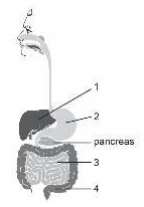
The diagram below shows the human alimentary canal.
1, 2, 3 and 4 are four different organs that are parts of the canal.

Image
8. Which of the labelled parts represents the liver?
A. 1
B. 2
C. 3
D. 4
9. Which of the following will be adversely affected in Mr. Ayub’s body?
Pancreas secretes lipase enzyme. Mr. Ayub is suffering from malfunctioning of the pancreas.
A. Digestion of carbohydrates
B. Digestion of proteins
C. Digestion of fats
D. Digestion of vitamins