Question
The table shows how different animals move.
Animal How does the animal move?
Frog Hop
Mouse Falk
Dragonly Fly
Earthworm Crawl
$1.$Which animal uses all of its body parts to move?
$A.$ Frog
$B.$ Mouse
$C.$ Dragonly
$D.$ Earthworm
$2.$What helps a frog hop?
$A.$ Strong leg muscles
$B.$ Short body length
$C.$ Two pairs of legs
$D.$ Absence of a tail
Answer

$1. D.$ Earthworm
$2. A.$ Strong leg muscles

Need a full question paper?

Generate a complete, print-ready paper with questions like this in minutes — across 16+ boards, with answer keys.

Start Generating Free

Similar questions

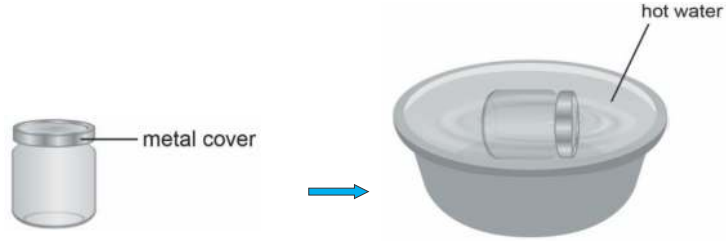
Leena had a glass container with butter cubes in it.
She could not open the metal cover as it was too tight.
Leena placed the container in a tumbler of hot water.Image
Leena took the container out of the hot water after $15$ minutes.
She was then able to remove the metal cover.
$5.$ How did hot water help in removing the metal cover?
$6.$ What is Leena likely to ind after taking the container out of hot water?
$A.$ Butter cubes have melted.
$B.$ Butter cubes have got larger.
$C.$ Butter cubes have got harder.
$D.$ Butter cubes have changed to a new substance
$7.$ Which of the following changes can be reversed?
Circle $‘Yes’$ or $‘No’$ to mark your response.
Can this change be reversed? $Yes$ or $No$
Melting of wax Yes/No
Shredding of paper Yes/No
Bending of rubber pipe Yes/No
$8.$ Which condition must be true for a permanent change?
$A.$ Change in shape
$B.$ Change in volume
$C.$ Loss or gain of heat
$D.$ New substance is formed
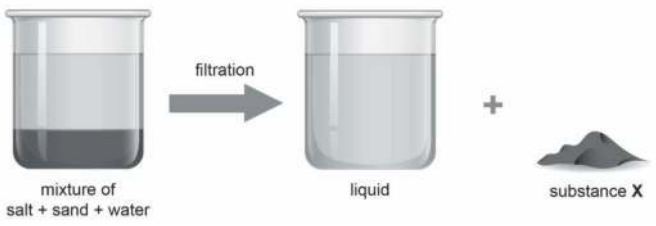
A beaker contains a mixture of salt, sand and water.
The mixture is iltered using ilter paper.Image
$8.$ What is substance $X$?
$9.$ Write a single separation method by which water can be separated from a mixture of salt, sand and water.
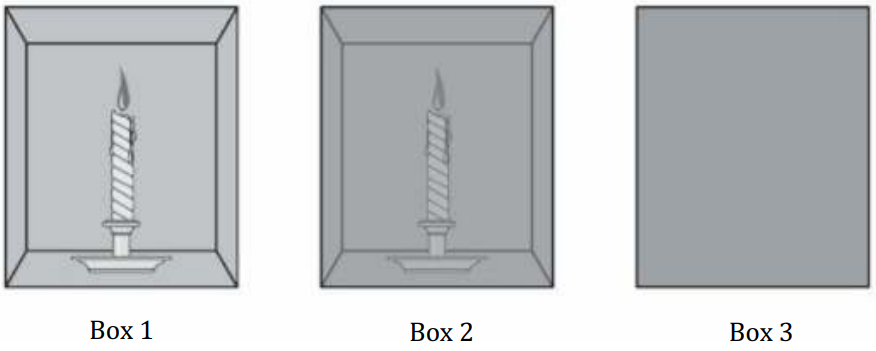
Namita has three boxes with the same thickness.
She places a burning candle inside each box.
The images show how Namita was able to view the candle through each box.Image
$7.$ Which box is made of an opaque material?
$8.$ Namita replaces box $1$ with a thicker box made of the same material and repeats the activity.
Will there be any change in the results of the activity? Explain your answer.
$9.$ Which object is commonly made of plastic?
$A.$ House gate
$B.$ Sleeping cot
$C.$ Cooking vessel
$D.$ Water bottle
$10.$ Neeraj spilled some water on the loor. He cleaned the loor using a mop. Which material is best suited for making the mop?
$A.$ Iron scrubber
$B.$ Cotton cloth
$C.$ Plastic sheet
$D.$ Copper sheet
The table below shows some common symptoms of nutrient deiciency.
Type of nutrient Symptoms due to its deiciency
Vitamin $A$ Poor vision, loss of vision at night
Calcium Weak bones, tooth decay
Vitamin $C$ Bleeding gums, wounds take longer to heal
Iodine Glands in the neck appear swollen
$6.$Pankaj is suffering from tooth decay and bleeding gums.
Which of the following nutrients in food would help him recover?
$A.$ Vitamin $A$ and calcium
$B.$ Calcium and vitamin $C$
$C.$ Vitamin $C$ and iodine
$D.$ Iodine and vitamin $A$
$7.$ Doctors advise not to boil fruits before eating.
What could be the likely reason for this? Circle $‘Yes’$ or $‘No’$ for each statement.
Why should fruits not be boiled before eating? $Yes$ or $No$?
Heating changes the colour of the fruit. $Yes/No$
Heating makes the fruit become soft. $Yes/No$
Heating destroys the vitamins present in the fruit. $Yes/No$
Fat-rich foods leave an oily patch on paper when smashed or rubbed on it.
Raju wanted to check this through an activity.
He performed the following steps.
Step $1:$ Placed a fat-rich food item on a piece of white paper
Step $2:$ Smashed the food gently with a hammer
Step $3:$ Removed the smashed food from the paper
Step $4:$ Dried the paper and then checked for any patch on it
$8.$ In Step $4$, Raju dried the paper before checking for patches.
What could be the most likely reason for this?
$9.$Raju performed the same activity with four types of food.
Which of the following will decide the amount of fat in each food item?
$A.$ The shape of the paper
$B.$ Time taken for the paper to dry
$C.$ The size of the oily patch on the paper
$D.$ Ease of smashing the food with hammer

Image
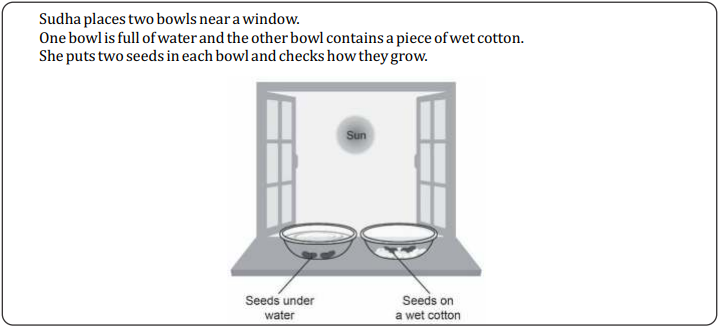
$9.$What is Sudha testing?

Image
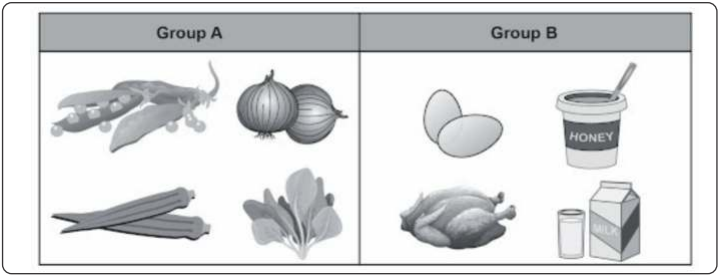
$3.$Which difference was used to put the foods into two groups?
$A.$ Colourful / White
$B.$ Plant source /Animal source
$C.$ More nutritious / Less nutritious
$D.$ Needs cooking / Does not need cooking
$4.$Which animal eats only the food from Group $A$?
$A.$ Cat
$B.$ Frog
$C.$ Eagle
$D.$ Deer
$5.$Which animal is an omnivore?
$A.$ Crow
$B.$ Eagle
$C.$ Rabbit
$D.$ Honey bee
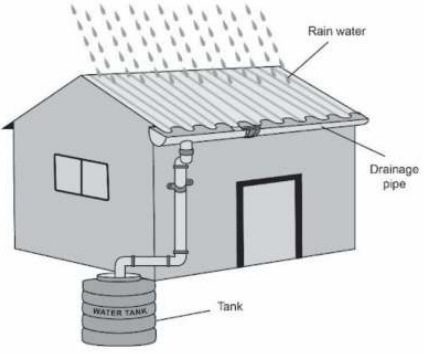
The picture shows how rainwater is stored in tanks for home use.Image
9. Is the water collected in the water tank safe for drinking? Explain your answer.
10. Why is rainwater harvesting important?
$A.$ To help plants grow better
$B.$ To reduce water pollution
$C.$ To collect water that is rich in minerals
$D.$ To reduce the demand for water supply
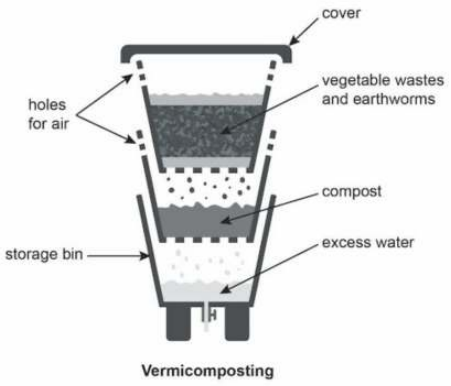
Vermicomposting is a process of recycling degradable waste.
Earthworms breakdown the waste into compost that can be use as manure.
The diagram shows the details of the process.
Image
$8.$ Which of these statements is true about vermicomposting?
$A.$ It breaks down waste naturally.
$B.$ It produces harmful substances.
$C.$ It requires the presence of light.
$D.$ It takes place in the absence of oxygen
$9.$ Why does vermicomposting require moist condition and moderate temperatures?
__________________________________________________________________________________________________________________________________________________________
$10.$ Which of these is true for the excess water obtained from vermicomposting?
$A.$ It contains earthworms.
$B.$ It is rich in mineral nutrients.
$C.$ It contains vegetable waste.
$D.$ It does not contain microorganisms.
Rohan wants to ind out which type of fabric best absorbs water.
He soaks four different types of fabrics in water for $15$ minutes.
He places each fabric on a sieve and allows the water to drain.
He then measured the mass of the wet fabrics.
Fabric type Mass of the wet fabric
Cotton $120\ g$
Silk $100\ g$
Polyester $85\ g$
Wool $110\ g$
$6.$What extra information does Rohan need to ind out which fabric best absorbs water?
$A.$ The time each fabric took to dry completely
$B.$ The mass of each fabric before soaking in water
$C.$ The amount of water in which the fabrics were soaked
$D.$ The temperature of the water in which the fabrics were soaked
$7.$What does Rohan need to keep the same for all the four fabrics?
Circle $‘Yes’$ or $‘No’$ for each row
Should this be kept same for all the four fabrics? $Yes$ or $No$
The colour of the fabrics $Yes/No$
The size of the fabrics $Yes/No$
The thickness of the fabrics $Yes/No$