MCQ
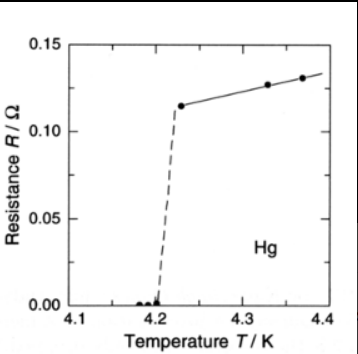
The temperature bellow which a material becomes a superconductor is called:
- ACritical temperature.
- BAbsolute temperature.
- CTripple point.
- DNone of the above.
Explanation:
Critical temperature is the temperature below which metals when taken exhibit zero resistivity and turns into a superconductor. The critical temperature varies with the individual material. Because these materials have no electrical resistance, meaning electrons can travel freely through them, they can carry large amounts of electrical current for long periods of time without losing energy as heat. The transition is so sudden and complete that it appears to be a transition to a different phase of matter; known as the superconducting phase.
Generate a complete, print-ready paper with questions like this in minutes — across 16+ boards, with answer keys.
The capacitor of capacitance 4μF and 6 μF are connected in series. A potential difference of 500 volts applied to the outer plates of the two capacitor system. Then the charge on each capacitor is numerically
|
(a) 6000 C |
(b) 1200 C |
(c) 1200 μC |
(d) 6000 μC |
The magnetic field to a small magnetic dipole of magnetic moment M, at distance r from the centre on the equatorial line is given by (in M.K.S. system)
|
(a) |
(b) |
(c) |
(d) |
Gauss is unit of which quantity
|
(a) H |
(b) B |
(c) ∅ |
(d) I |
The ratio of thermionic currents (I/I0) for a metal when the temperature is slowly increased  to T as shown in figure. (I and I0 are currents at T and respectively). Then which one is correct?
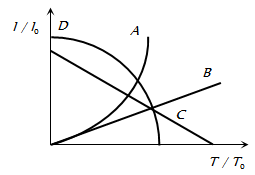
| (a) A | (b) B | (c) C | (d) D |
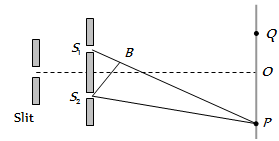
In the figure is shown Young’s double slit experiment. Q is the position of the first bright fringe on the right side of O. P is the 11th fringe on the other side, as measured from Q. If the wavelength of the light used is 6000  , then
  will be equal to
|
(a) 6 |
(b) 6.6 |
(c) 3.138 |
(d) 3.144 |
A very high magnetic field is applied to a stationary charge. Then the charge experiences
|
(a) A force in the direction of magnetic field |
|
(b) A force perpendicular to the magnetic field |
|
(c) A force in an arbitrary direction |
|
(d) No force |
In a Young’s double slit experiment, the slit separation is 1 mm and the screen is 1 m from the slit. For a monochromatic light of wavelength 500 nm, the distance of 3rd minima from the central maxima is
|
(a) 0.50 mm |
(b) 1.25 mm |
(c) 1.50 mm |
(d) 1.75 mm |
A wire of length L and 3 identical cells of negligible internal resistances are connected in series. Due to current, the temperature of the wire is raised by ∆ T in a time t. A number N of similar cells is now connected in series with a wire of the same material and cross – section but of length 2 L. The temperature of the wire is raised by the same amount ∆ T in the same time t. the value of N is
|
(a) 4 |
(b) 6 |
(c) 8 |
(d) 9 |
The number of revolutions per second made by an electron in the first Bohr orbit of hydrogen atom is of the order of 3
|
(a) |
(b) |
(c) |
(d) |


