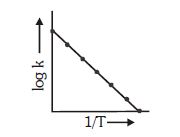
- A$\frac{{{E_a}}}{{RT}}$
- ✓$- \frac{{{E_a}}}{{2.303R}}$
- C$ - \frac{{{E_a}}}{{2.303RT}}\log \,A$
- D$- \frac{{{E_a}}}{{2.303}}\,\frac{R}{T}$

$\ln K =\ln \left( Ae ^{- E _{ a } / R T}\right)$
$\ln K =\ln A +\left(-\frac{ E _{ a }}{ RT }\right) \ln e$
$\ln K =\ln A -\frac{ E _{ a }}{ RT }...(1)$
now changing $\ln$ to $\log$
$\log K =\log A +\left(-\frac{ E _{ a }}{2.303 R }\right) \frac{1}{ T }...(2)$
this represent straight time as: $y = c +( m ) x$
$\therefore$ slope $=-\frac{ E _{ a }}{2.303 R }$
Generate a complete, print-ready paper with questions like this in minutes — across 16+ boards, with answer keys.
$SF _{4}, BF _{4}^{-}, CIF _{3}, AsF _{3}, PCl _{5}, BrF _{5}, XeF _{4}, SF _{6}$
$A.$ $E _{\text {cell }}$ is an intensive parameter.
$B.$ A negative $E^{\Theta}$ means that the redox couple is a stronger reducing agent than the $H ^{+} / H _2$ couple.
$C.$ The amount of electricity required for oxidation or reduction depends on the stoichiometry of the electrode reaction.
$D.$ The amount of chemical reaction which occurs at any electrode during electrolysis by a current is proportional to the quantity of electricity passed through the electrolyte.


Reason : Free energy change for this process is positive.