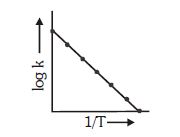
- A$\frac{{{E_a}}}{{RT}}$
- ✓$- \frac{{{E_a}}}{{2.303R}}$
- C$ - \frac{{{E_a}}}{{2.303RT}}\log \,A$
- D$- \frac{{{E_a}}}{{2.303}}\,\frac{R}{T}$

$\ln K =\ln \left( Ae ^{- E _{ a } / R T}\right)$
$\ln K =\ln A +\left(-\frac{ E _{ a }}{ RT }\right) \ln e$
$\ln K =\ln A -\frac{ E _{ a }}{ RT }...(1)$
now changing $\ln$ to $\log$
$\log K =\log A +\left(-\frac{ E _{ a }}{2.303 R }\right) \frac{1}{ T }...(2)$
this represent straight time as: $y = c +( m ) x$
$\therefore$ slope $=-\frac{ E _{ a }}{2.303 R }$
Generate a complete, print-ready paper with questions like this in minutes — across 16+ boards, with answer keys.

$C{H_3} - CH = CH - COOH\xrightarrow{{B{r_2}}}$

$\mathrm{A} \stackrel{700 \mathrm{K}}{\rightarrow}$ Product
$\mathrm{A}\xrightarrow[\text { catalyst }]{500 \mathrm{K}} $ Product
it was found that $\mathrm{E}_{\mathrm{a}}$ is decreased by $30 \;\mathrm{kJ} / \mathrm{mol}$ in the presence of catalyst.
If the rate remains unchanged, the activation energy for catalysed reaction is (Assume pre exponential factor is same $):$