MCQ
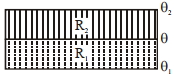
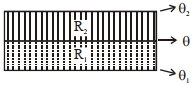
The temperature $\theta$ at the junction of two insulating sheets, having thermal resistances $R _{1}$ and $R _{2}$ as well as top and bottom temperatures $\theta_{1}$ and $\theta_{2}$ (as shown in figure) is given by
  • A
    $\frac{\theta_{1} R_{1}+\theta_{2} R_{2}}{R_{1}+R_{2}}$
  • B
    $\frac{\theta_{1} R _{2}-\theta_{2} R _{1}}{ R _{2}- R _{1}}$
  • $\frac{\theta_{1} R _{2}+\theta_{2} R _{1}}{ R _{1}+ R _{2}}$
  • D
    $\frac{\theta_{1} R_{1}+\theta_{2} R_{2}}{R_{1}+R_{2}}$
Answer

Correct option: C.
$\frac{\theta_{1} R _{2}+\theta_{2} R _{1}}{ R _{1}+ R _{2}}$
c
Heat flow rate will be same through both

$\therefore \frac{\theta_{1}-\theta}{ R _{1}}=\frac{\theta-\theta_{2}}{ R _{2}}$

$R _{2} \theta_{1}- R _{2} \theta= R _{1} \theta- R _{1} \theta_{2}$

$\theta=\frac{ R _{2} \theta_{1}+ R _{1} \theta_{2}}{ R _{1}+ R _{2}}$

Need a full question paper?

Generate a complete, print-ready paper with questions like this in minutes — across 16+ boards, with answer keys.

Start Generating Free

Similar questions

A system $X$ is neither in thermal equilibrium with $Y$ nor with $Z$. The systems $Y$ and $Z$:
To reduce the least count error, instruments need higher:
Two cars $A$ and $B$ move along a concentric circular path of radius $r_A$ and $r_B$ with velocities $v_A$ and $v_B$ maintaining constant distance, then $\frac{\text{v}_\text{A}}{\text{v}_\text{B}}$ is equal to:
When a capillary is dipped in water, water rises $0.015$ min it. If the surface tension of water is $75×10^{-3}\, N/m$, the radius of capillary is ....... $mm$
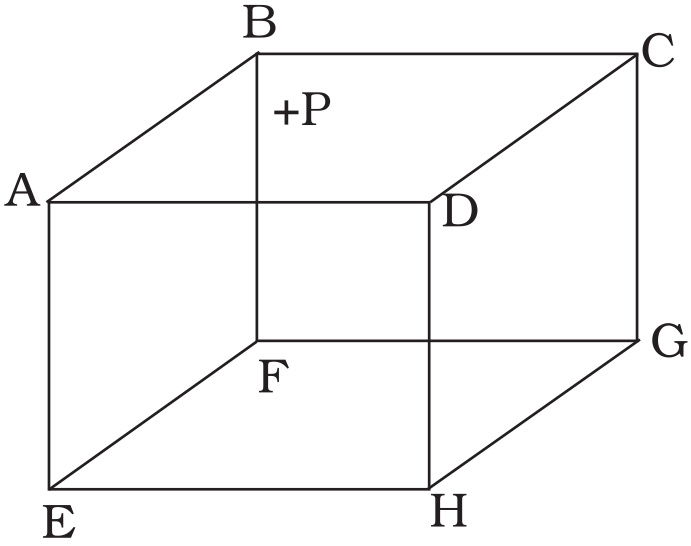
$\text{ABCDEFGH}$ is a hollow cube made of an insulator $($figure$)$ face $\text{ABCD}$ has positive charge on it. Inside the cube, we have ionised hydrogen. The usual kinetic theory expression for pressure.
A device used to measure very high temperature is
A particle of mass $m$ moving with a velocity $v$ strikes a stationary particle of mass $2m$ and stickes to it. The speed of the system will be,
The upper half of an inclined plane of inclination $\theta$ is perfectly smooth while lower half is rough. A block starting from rest at the top of the plane will again come to rest at the bottom, if the coefficient of friction between the block and lower half of the plane is given by 
In the following figures heat is absorbed by the gas
A capillary tube of radius $R$ is immersed in water and water rises in it to a height $H.$ Mass of water in capillary tube is $M$. If the radius of the tube is doubled, mass of water that will rise in capillary will be: