MCQ
The tenth elements in the periodic table resembles with the
  • A
    First period
  • Second period
  • C
    Fourth group
  • D
    Ninth group

Answer

Correct option: B.
Second period
b
$(b)$ Each period consists of a series of elements whose atom have the same principal quantum no. $(n)$ of the outer most shell i.e. In second period $n = 2$, this shell has four orbitals (one $2s$ and three $2p$) which can have eight electrons, hence second period contains $8$ elements from atomic no. $3$ to $10.$

Need a full question paper?

Generate a complete, print-ready paper with questions like this in minutes — across 16+ boards, with answer keys.

Start Generating Free

Similar questions

Which of the following is isoelectronic with carbon atom
Which of the following equilibrium is not shifted by increase in the pressure
Which of the following statements are correct?

$A$. Glycerol is purified by vacuum distillation because it decomposes at its normal boiling point.

$B$. Aniline can be purified by steam distillation as aniline is miscible in water.

$C$. Ethanol can be separated from ethanol water mixture by azeotropic distillation because it forms azeotrope.

$D$. An organic compound is pure, if mixed $M.P$. is remained same.

Choose the most appropriate answer from the options given below :

${H_3}B{O_3}\,\xrightarrow{{{T_1}}}X\,\xrightarrow{{{T_2}}}Y\,\xrightarrow{{\operatorname{Re} d\,\,\,hot}}{B_2}{O_3}$

if $T_1 < T_2$ then $X$ and $Y$ respectively are

The halogen which get easily reduced that is :
Identify the correct decreasing order of priority of the functional groups from the following :
Each of the following options contains a set of four molecules. Identify the option($s$) where all four molecules possess permanent dipole moment at room temperature.

$(1)$ $BeCl _2, CO _2, BCl _3, CHCl _3$

$(2)$ $SO _2, C _6 H _5 Cl , H _2 Se , BrF _5$

$(3)$ $BF _3, O _3, SF _6, XeF _6$

$(4)$ $NO _2, NH _3, POCl _3, CH _3 Cl$

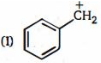
Which of the following options is the correct order of relative stabilities of cations $I, II$ and $III$ as written below (most stable first) ?

$(II)\,\,\,{{H}_{2}}C=CH-C{{H}_{2}}-\overset{+}{\mathop{C}}\,H-C{{H}_{3}}$

$(III)\,\,\,\begin{matrix}
   \,\,\,\,\,C{{H}_{3}}\,  \\
   |\,  \\
   {{H}_{3}}C-C-\overset{+}{\mathop{C}}\,{{H}_{2}}  \\
   |\,  \\
   \,\,\,C{{H}_{3}}  \\
\end{matrix}$
The $IUPAC$ name of the compound $CHO - {(C{H_2})_4} - COOH$
In the extraction of aluminium the electrolyte is