The terminal velocity of a small sphere of radius $a$ in a viscous liquid is proportional to
AIEEE 2012,AIIMS 2004, Easy


Download our appand get started for free
Experience the future of education. Simply download our apps or reach out to us for more information. Let's shape the future of learning together!No signup needed.*
Similar Questions
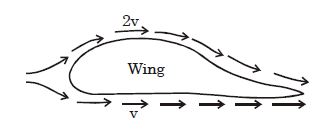
- 1The flow speeds of air on the lower and upper surfaces of the wing of an aeroplane are $v$ and $2v$ respectively. The density of air is $\rho $ and surface area of wing is $A$ . The dynamic lift on the wing isView Solution
- 2Two large, identical water tanks, $1$ and $2$ , kept on the top of a building of height $H$, are filled with water up to height $h$ in each tank. Both the tanks contain an identical hole of small radius on their sides, close to their bottom. A pipe of the same internal radius as that of the hole is connected to tank $2$ , and the pipe ends at the ground level. When the water flows the tanks $1$ and $2$ through the holes, the times taken to empty the tanks are $t_1$ and $t_2$, respectively. If $H=\left(\frac{16}{9}\right) h$, then the ratio $t_1 / t_2$ is. . . . .View Solution
- 3View SolutionAn open cubical tank was initially fully filled with water. When the tank was accelerated on a horizontal plane along one of its side it was found that one third of volume of water spilled out. The acceleration was
- 4A spherical ball of radius $1 \times 10^{-4} \mathrm{~m}$ and density $10^5$ $\mathrm{kg} / \mathrm{m}^3$ falls freely under gravity through a distance $h$ before entering a tank of water, If after entering in water the velocity of the ball does not change, then the value of $h$ is approximately:View Solution
(The coefficient of viscosity of water is $9.8 \times 10^{-6}$ $\left.\mathrm{N} \mathrm{s} / \mathrm{m}^2\right)$
- 5For the situation shown in the figure, water flows on the surface of a fixed plate. TheView Solution
velocity of water as a function of distance $'y'$ is given as : $u = \alpha \left[ {\frac{y}{h} - 2{{\left( {\frac{y}{h}} \right)}^2}} \right]$ . Determine the magnitude of the shear stress that the water applies at the base of the plate. Coefficient of viscosity is $\eta$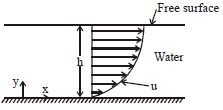
- 6A plastic circular disc of radius $R$ is placed on a thin oil film, spread over a flat horizontal surface. The torque required to spin the disc about its central vertical axis with a constant angular velocity is proportional toView Solution
- 7A flat plate moves normally with a speed ${v_1}$ towards a horizontal jet of water of uniform area of cross-section. The jet discharges water at the rate of volume $V$ per second at a speed of ${v_2}$. The density of water is $\rho $. Assume that water splashes along the surface of the plate at right angles to the original motion. The magnitude of the force acting on the plate due to the jet of water isView Solution
- 8A spherical ball of density $\rho$ and radius $0.003$ $m$ is dropped into a tube containing a viscous fluid filled up to the $0$ $ cm$ mark as shown in the figure. Viscosity of the fluid $=$ $1.260$ $N.m^{-2}$ and its density $\rho_L=\rho/2$ $=$ $1260$ $kg.m^{-3}$. Assume the ball reaches a terminal speed by the $10$ $cm$ mark. The time taken by the ball to traverse the distance between the $10$ $cm$ and $20$ $cm$ mark isView Solution
( $g$ $ =$ acceleration due to gravity $= 10$ $ ms^{^{-2}} )$

- 9View SolutionSelect the correct statement regarding stream line flow
- 10An open $U$-tube contains mercury. When $13.6 \,cm$ of water is poured into one of the arms of the tube, then the mercury rise in the other arm from its initial level is ....... $cm$View Solution