Question
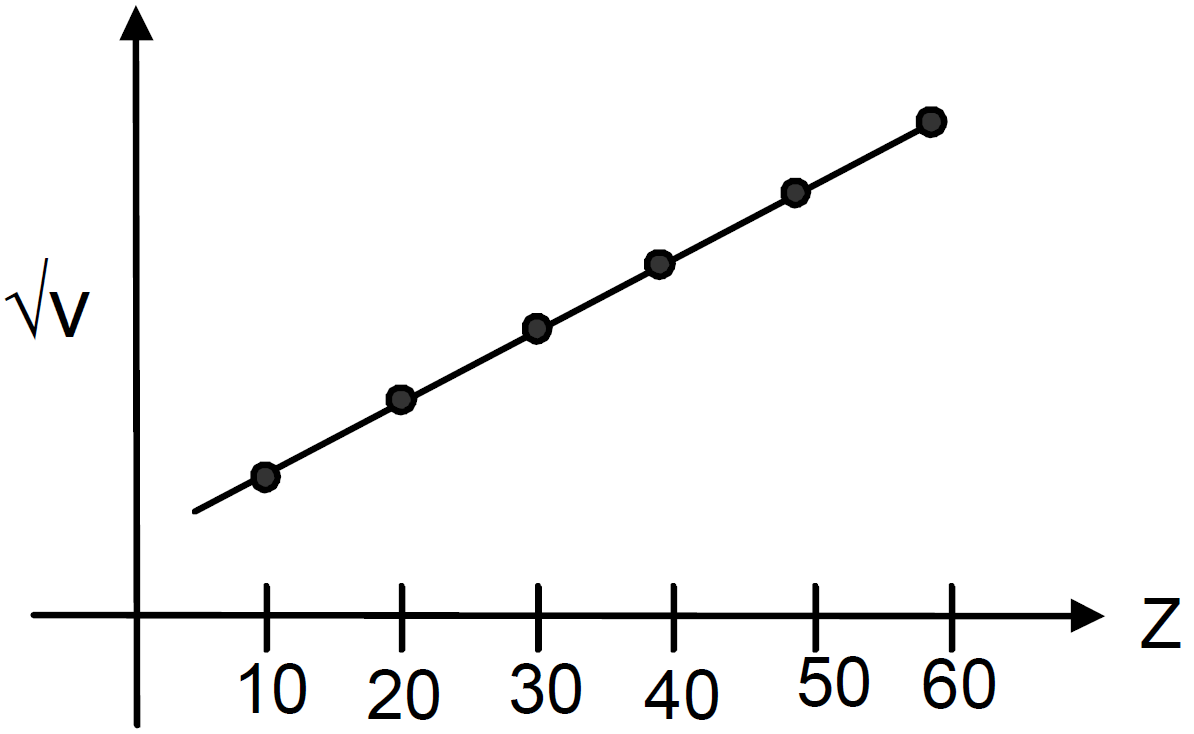
The $\text{K}_\beta$ X-rays from certain elements are given below. Draw a Moseley-type plot of $\sqrt{\text{v}}$ versus Z for $\text{K}_\beta$ radiation.
Element
Ne
P
Ca
Mn
Zn
Br
Energy (keV)
0.858
2.14
4.02
6.51
9.57
13.3

Answer


$\text{K}_\text{B}$ radiation is when the e jumps from
n = 3 to n = 1 (here n is principal quantum no)
$\Delta\text{E}=\text{hv}=\text{Rhc(z-h)}^2\Big(\frac{1}{2^2}-\frac{1}{3^2}\Big)$
$\sqrt{\text{v}}=\sqrt{\frac{9\text{RC}}{8}}(\text{z}-\text{h})$
$\therefore\sqrt{\text{v}}\propto\text{z}$
Second method :
We can directly get value of v b
hv = Energy
$\Rightarrow\text{v}=\frac{\text{Energy(in Kev)}}{\text{h}}$
This we have to find out $\sqrt{\text{v}}$ and draw the same graph as above.

Need a full question paper?

Generate a complete, print-ready paper with questions like this in minutes — across 16+ boards, with answer keys.

Start Generating Free

Similar questions

Can $\text{L}_\alpha$ X-ray of one material have shorter wavelength than $\text{K}_\alpha$ X-ray of another?
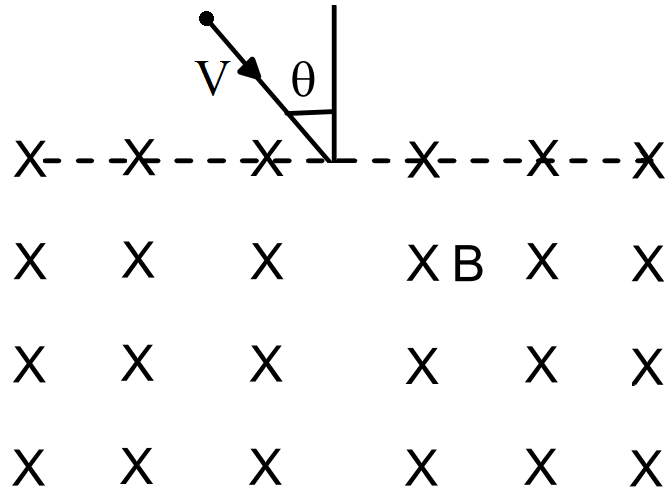
A particle of mass m and positive charge q, moving with a uniform velocity v, enters a magnetic field B, as shown,
  1. Find the radius of the circular arc it describes in the magnetic field.
  2. Find the angle subtended by the arc at the centre.
  3. How long does the particle stay inside the magnetic field?
  4. Solve the three parts of the above problem if the charge q on the particle is negative.
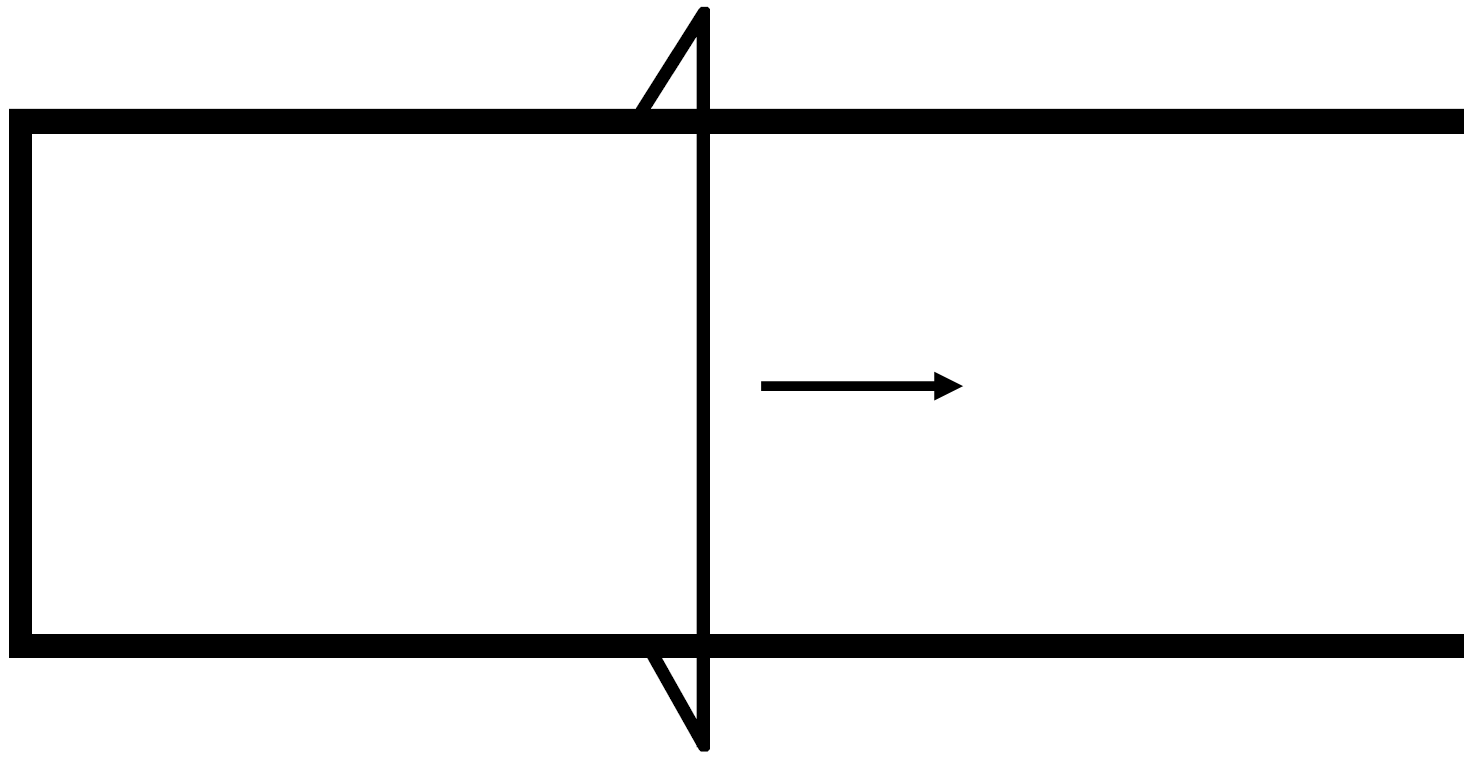
Figure shows a metallic wire of resistance $0.20\Omega$ sliding on a horizontal, U-shaped metallic rail. The separation between the parallel arms is 20cm. An electric current of $2.0\mu\text{A}$ passes through the wire when it is slid at a rate of $20cms^{-1}$. If the horizontal component of the earth's magnetic field is $3.0 \times 10^{-5} T$, calculate the dip at the place.
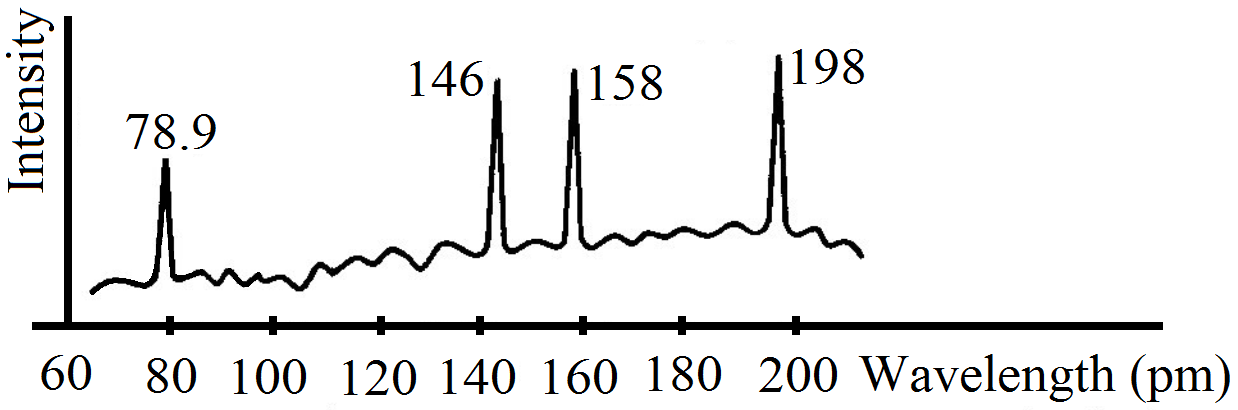
Continuous X-rays are made to strike a tissue paper soaked with polluted water. The incoming X-rays excite the atoms of the sample by knocking out the electrons from the inner shells. Characteristic X-rays are analysed and the intensity is plotted against the wavelength. Assuming that only $\text{K}_\alpha$ intensities are detected, list the elements present in the sample from the plot. Use Moseley's equation $v - (25 \times 10^{14}Hz)(Z - 1)^2.$
Derive the expression for the magnetic field at the site of a point nucleus in a hydrogen atom due to the circular motion of the electron. Assume that the atom is in its ground state and give the answer in terms of fundamental constants.
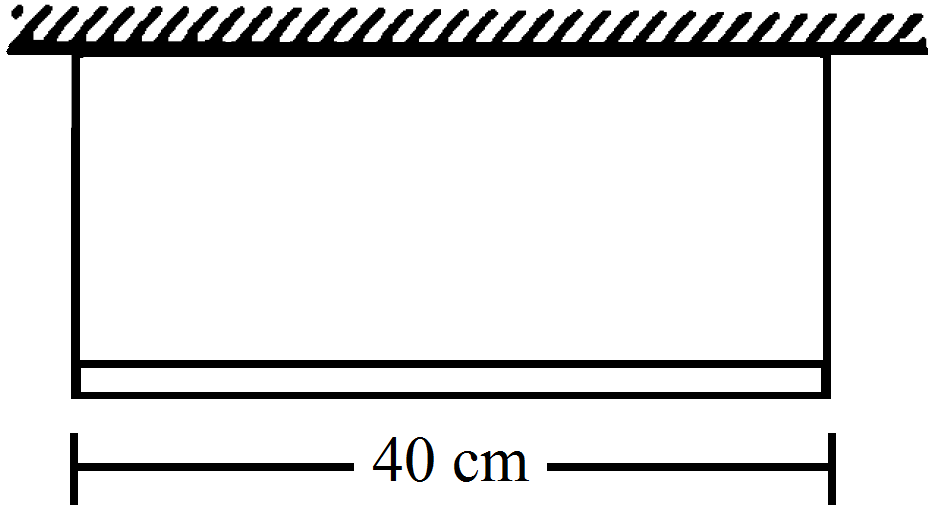
A uniform horizontal rod of length 40cm and mass 1.2kg is supported by two identical wires as shown in figure, Where should a mass of 4.8kg be placed on the rod so that the same tuning fork may excite the wire on left into its fundamental vibrations and that on right into its first overtone? Take $g = 10m/s^2.$
A copper wire of radius 0.1mm and resistance $1\text{k}\Omega$ is connected across a power supply of 20V.
(a) How many electrons are transferred per second between the supply and the wire at one end? (b) Write down the current density in the wire.
A room has AC run for 5 hours a day at a voltage of 220V. The wiring of the room consists of Cu of 1mm radius and a length of 10m. Power consumption per day is 10 commercial units. What fraction of it goes in the joule heating in wires? What would happen if the wiring is made of aluminium of the same dimensions?
$[\rho _{cu} = 1.7 \times 10^{-8}_{Ωm} , \rho _{Al} = 2.7 \times 10^{-8} Ωm]$
Suppose the rod with the balls A and B of the previous problem is clamped at the centre in such a way that it can rotate freely about a horizontal axis through the clamp. The system is kept at rest in the horizontal position. A particle P of the same mass m is dropped from a height h on the ball B. The particle collides with B and sticks to it:
  1. Find the angular momentum and the angular speed of the system just after the collision.
  2. What should be the minimum value of h so that the system makes a full rotation after the collision.
The switch S shown in figure. is kept closed for a long time and is then opened at t = 0. Find the current in the middle $1.0\Omega$ resistor at t = 1ms.