MCQ
The thermionic emission of electron is due to
  • A
    Electromagnetic field
  • B
    Electrostatic field
  • High temperature
  • D
    Photoelectric effect

Answer

Correct option: C.
High temperature
c
The thermionic emission of electron is due to High temperature.

Need a full question paper?

Generate a complete, print-ready paper with questions like this in minutes — across 16+ boards, with answer keys.

Start Generating Free

Similar questions

Four resistances $10$ $\Omega$, $5$ $\Omega$, $7$ $\Omega$ and $3$ $\Omega$ are connected so that they form the sides of a rectangle $AB$, $BC$, $CD$ and $DA$ respectively. Another resistance of $10$ $\Omega$ is connected across the diagonal $AC$. The equivalent resistance between $A$ and $B $ is .............. $\Omega$
The penetration of light into the region of geometrical shadow is called
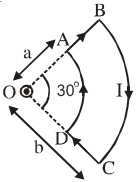
A current loop $ABCD$ is held fixed on the plane of the paper as shown in the figure. The arcs $ BC$ (radius $= b$) and $DA $ (radius $= a$) of the loop are joined by two straight wires $AB $  and $CD$. A steady current $I$ is flowing in the loop. Angle made by $AB$ and $CD$ at the origin $O$ is $30^o $. Another straight thin wire with steady current $I_1$ flowing out of the plane of the paper is kept at the origin.

Due to the presence of the current $I_1$ at the origin
In a particle accelerator, a current of $500 \,\mu A$ is carried by a proton beam in which each proton has a speed of $3 \times 10^7 \,m / s$. The cross-sectional area of the beam is $1.50 \,mm ^2$. The charge density in this beam (in $C / m ^3$ ) is close to
A $10\,\mu F$ capacitor and a $20\,\mu F$ capacitor are connected in series across a $200\;V$ supply line. The charged capacitors are then disconnected from the line and reconnected with their positive plates together and negative plates together and no external voltage is applied. What is the potential difference across each capacitor
A uniform beam of positively charged particles is moving with a constant velocity parallel to another beam of negatively charged particles moving with the same velocity in opposite direction separated by a distance $d.$ The variation of magnetic field $B$ along a perpendicular line draw between the two beams is best represented by
Binding energy per nucleon of a fixed nucleus $X^A$ is $8\ MeV$ . It absorbs a neutron moving with kinetic energy $2\ MeV$ and converts into $Y$ , emitting two photon of energy $1\ MeV$ and $4\ MeV$ respectively one after the other. The binding energy of per nucleon of $Y$ (in $MeV$ ) is
A pendulum clock that keeps correct time on the earth is taken to the moon. It will run:
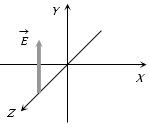
The figure here gives the electric field of an $EM$ wave at a certain point and a certain instant. The wave is transporting energy in the negative $z$ direction. What is the direction of the magnetic field of the wave at that point and instant
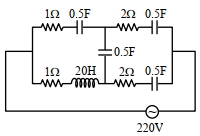
At very high frequencies, the effective impendance of the given circuit will be $....\Omega$