Question
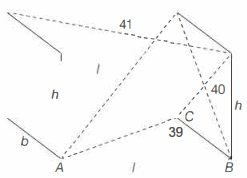
The three different face diagonals of a cuboid (rectangular parallelopiped) have lengths $39,40,41$. The length of the main diagonal of the cuboid which joins a pair of opposite corners is

Answer

a
(a)

Let the length, breadth and height of cuboid is $l, b$ and $h$ respectively.

$Given, l^2+h^2=39^2$

$\Rightarrow b^2+h^2=40^2$

$\Rightarrow \quad l^2+b^2=41^2$

$\Rightarrow \quad 2\left(l^2+b^2+h^2\right)=39^2+40^2+41^2$

$\Rightarrow \quad l^2+b^2+h^2=2401$

$\therefore$ Length of longest diagonal

$=\sqrt{l^2+b^2+h^2}$

$=\sqrt{2401}=49$
Need a full question paper?

Generate a complete, print-ready paper with questions like this in minutes — across 16+ boards, with answer keys.

Start Generating Free

Similar questions

The number of seven digits odd numbers, that can be formed using all the seven digits $1, 2, 2, 2, 3, 3, 5$ is $.......$
The number of non-zero terms in the expansion of ${(1 + 3\sqrt 2 x)^9} + {(1 - 3\sqrt 2 x)^9}$ is
Let $\left\{a_{n}\right\}_{n-1}^{\infty}$ be a sequence such that $a_{1}=1, a_{2}=1$ and $a_{n+2}=2 a_{n+1}+a_{n}$ for all $n \geq 1 .$ Then tha value of $47 \sum_{n=1}^{\infty} \frac{a_{n}}{2^{3 n}}$ is equal to $.....$
The $\mathop {\lim }\limits_{x \to 0} {(\cos x)^{\cot x}}$ is
The chances to fail in Physics are $20\%$ and the chances to fail in Mathematics are $10\%$. What are the chances to fail in at least one subject ............ $\%$
$(\sec A + \tan A - 1)(\sec A - \tan A + 1) - 2\tan A = $
If the foot of the perpendicular drawn from the point $(1,0,3)$ on a line passing through $(\alpha, 7,1)$ is $\left(\frac{5}{3}, \frac{7}{3}, \frac{17}{3}\right),$ then $\alpha$ is equal to
If the shortest distance between the line $\vec{r}=(-\hat{i}+3 \hat{k})+\lambda(\hat{i}-a \hat{j})$ and $\vec{r}=(-\hat{j}+2 \hat{k})+\mu(\hat{i}-\hat{j}+\hat{k})$ is $\sqrt{\frac{2}{3}}$, then the integral value of $a$ is equal to
If the vertex of the parabola $y = {x^2} - 8x + c$ lies on $x$ - axis, then the value of $c$ is
If three mutually perpendicular lines have direction cosines $({l_1},{m_1},{n_1}),({l_2},{m_2},{n_2})$ and $({l_3},{m_3},{n_3})$, then the line having direction cosines ${l_1} + {l_2} + {l_3}$, ${m_1} + \,\,{m_2} + \,\,{m_3}$ and ${n_1} + {n_2} + {n_3}$ make an angle of ..…… $^o$ with each other