MCQ
The three different face diagonals of a cuboid (rectangular parallelopiped) have lengths $39,40,41$. The length of the main diagonal of the cuboid which joins a pair of opposite corners is
- ✓$49$
- B$49 \sqrt{2}$
- C$60$
- D$60 \sqrt{2}$
Let the length, breadth and height of cuboid is $l, b$ and $h$ respectively.
$Given, l^2+h^2=39^2$
$\Rightarrow b^2+h^2=40^2$
$\Rightarrow \quad l^2+b^2=41^2$
$\Rightarrow \quad 2\left(l^2+b^2+h^2\right)=39^2+40^2+41^2$
$\Rightarrow \quad l^2+b^2+h^2=2401$
$\therefore$ Length of longest diagonal
$=\sqrt{l^2+b^2+h^2}$
$=\sqrt{2401}=49$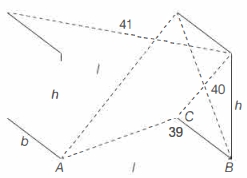
Generate a complete, print-ready paper with questions like this in minutes — across 16+ boards, with answer keys.
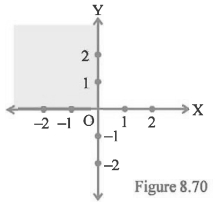
$L _1: x \sqrt{2}+ y -1=0$ and $L _2: x \sqrt{2}- y +1=0$
For a fixed constant $\lambda$, let $C$ be the locus of a point $P$ such that the product of the distance of $P$ from $L_1$ and the distance of $P$ from $L_2$ is $\lambda^2$. The line $y=2 x+1$ meets $C$ at two points $R$ and $S$, where the distance between $R$ and $S$ is $\sqrt{270}$.
Let the perpendicular bisector of $RS$ meet $C$ at two distinct points $R ^{\prime}$ and $S ^{\prime}$. Let $D$ be the square of the distance between $R ^{\prime}$ and $S ^{\prime}$.
($1$) The value of $\lambda^2$ is
($2$) The value of $D$ is