Question
The time period of a mass hanging from an ideal spring is 2 seconds. If along with it 2 kg if the mass is added and the time period becomes 3 seconds find the value of $m$.

Answer

When a mass of $m$ hung then the time period is T , then
$T=2 \pi \sqrt{\frac{m}{k}}\ldots\ldots (1)$
Where, $k=$ force constant of the spring $(m+2) kg$ 's mass hung then time period is $T ^{\prime}$ so,
$T^{\prime}=2 \pi \sqrt{\frac{m+2}{k}}\ldots\ldots (2)$
Equation (2) divided by (1)
$\frac{T^{\prime}}{T}=\sqrt{\frac{m+2}{m}}$
Given: $T =2$ seconds, $T ^{\prime}=3$ seconds
$\frac{3}{2}=\sqrt{\frac{m+2}{m}}=\frac{9}{4}=\frac{m+2}{m}$
$\text {or}\quad 9 m=4 m+8$
$\Rightarrow5 m=8$
$\Rightarrow  m=\frac{8}{5}=1.6 kg$

Need a full question paper?

Generate a complete, print-ready paper with questions like this in minutes — across 16+ boards, with answer keys.
Start Generating Free

Similar questions

Establish a relation between linear velocity and angular velocity in a uniform circular motion and explain the direction of linear velocity.
A woman throws an object of mass $500g$ with a speed of $25m s^1$. If the object hits a wall and rebounds with half the original speed, what is the change in momentum of the object?
A man of mass $70kg$ stands on a weighing scale in a lift which is moving. Downwards with a uniform acceleration of $5ms^{-2}$.
A liquid-nitrogen container is made of a 1cm thick styrofoam sheet having thermal conductivity $0.025\text{Js}^{-1}\text{m}^{-1}{^\circ}\text{C}^{-1}.$ Liquid nitrogen at 80K is kept in it. A total area of $0.80m^2$ is in contact with the liquid nitrogen. The atmospheric temperature is 300K. Calculate the rate of heat flow from the atmosphere to the liquid nitrogen.
Why are the magnification properties of microscopes and telescopes defined in terms of the ratio of angles and not in terms of the ratio of sizes of objects and images?
A planet moves around the sun in a circular orbit. The time period of revolution $T$ of the planet depends on
  1. Radius of the orbit $(R)$.
  2. Mass of the sun $M$.
  3. Gravitational constant $G$.
Show dimensionally that $\text{T}^2\propto\text{R}^3$
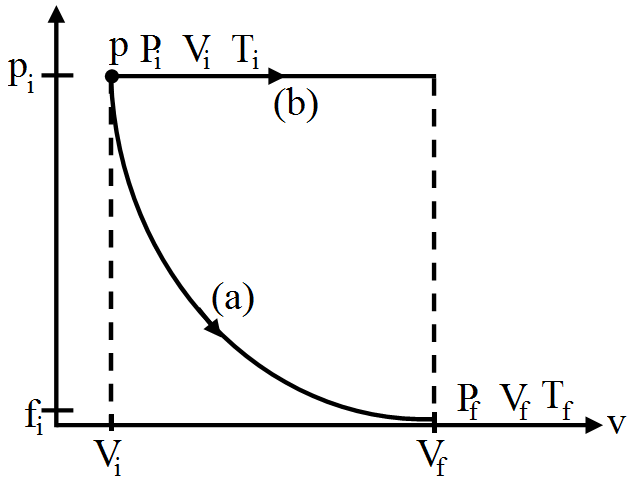
The initial state of a certain gas is $(P_i , V_i , T_i )$. It undergoes expansion till its volume becoms $V_f$ . Consider the following two cases:
  1. The expansion takes place at constant temperature.
  2. The expansion takes place at constant pressure.
Plot the $P-V$ diagram for each case. In which of the two cases, is the work done by the gas more?
Two insulating small spheres are rubbed against each other and placed 1cm apart. If they attract each other with a force of 0.1N, how many electrons were transferred from one sphere to the other dunng rubbing?
Eight rain drops of radius 1 mm each falling down with terminal velocity of $5 cms ^{-1}$ coalesce to form a bigger drop. Find the terminal velocity of the bigger drop.
A student records the initial length l, change in temperature $\Delta\text{T}$ and change in length $\Delta\text{l}$ of a rod as follows:
S.NO.
l(m)
$\Delta\text{T(C)}$
$\Delta\text{l}(\text{m})$
$1.$
$2
$10
$4 \times 10^{-4}$
$2.
$1
$10
$4 \times 10^{-4}$
$3.
$2
$20
$2 \times 10^{-4}$
$4.
$3
$10
$6 \times 10^{-4}$
If the first observation is correct, what can you say about observations 2, 3 and 4.