MCQ
The time period of an earth-satellite in circular orbit is independent of:
  • The mass of the satellite.
  • B
    Radius of the orbit.
  • C
    None of them.
  • D
    Both of them.

Answer

Correct option: A.
The mass of the satellite.
The time period of an earth-satellite in circular orbit is independent of the mass of the satellite, but depends on the radius of the orbit.

Need a full question paper?

Generate a complete, print-ready paper with questions like this in minutes — across 16+ boards, with answer keys.
Start Generating Free

Similar questions

A one metre long (both ends open) organ pipe is kept in a gas that has double the density of air at $STP$. Assuming the speed of sound in air at $STP$ is $300\; \mathrm{m} / \mathrm{s}$, the frequency difference between the fundamental and second harmonic of this pipe is ___ $\mathrm{Hz}$
If the velocity varies parabolically, how does the acceleration vary?
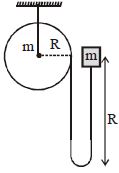
Mass of the pulley is $m$ & radius is $R$. Assume pulley to be uniform disc. Pulley is free to rotate about an axis passing through its centre and perpendicular to its plane. String is massless & inextensible. String is wrapped on the pulley. There is no slipping between string and pulley. The length of the string which is not wrapped on the pulley is $2R$. Block of mass $m$ is released from the position as shown in the figure. The impulse exerted by the string on the pulley at the moment string becomes taut is $J. \frac{2m \sqrt{gR}}{J}$ is equal to.
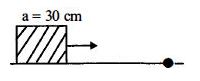
A cubical block of side $30\,cm$  is moving with  velocity $2\,\,ms^{-1}$ on a smooth horizontal surface. The surface has a bump at a point $O$ as shown in figure. The angular velocity (in rad/s) of the block immediately after it hits the bump, is
Sand is being dropped on a conveyer belt at the rate of $M\, kg/s.$ The force necessary to keep the belt moving with a constant velocity of $v\,m/s$ will be
Radiation from a black body at the thermodynamic temperature $T_1$ is measured by a small detector at distance $d_1$ from it. When the temperature is increased to $T_2$ and the distance to $d_2$ , the power received by the detector is unchanged . What is the ratio $d_2/d_1$ ?
A ball is dropped vertically downwards from a height $h$ above the ground. It hits the ground inelastically and bounces up vertically. Neglecting subsequent motion and air resistance, which of the following graph represents variation between speed $(v)$ and height $(h)$ correctly?
By stretching the rubber strings of a catapult we store $..........$ energy in it.
Which of the following pairs is wrong
Two paper screens $A$ and $B$ are separated by distance $100 \,m$. A bullet penetrates $A$ and $B$, at points $P$ and $Q$ respectively, where $Q$ is $10 \,cm$ below $P$. If bullet is travelling horizontally at the time of hitting $A$, the velocity of bullet at $A$ is nearly .......... $m / s$