MCQ
The time period of polar satellites is about ..........
  • A
    $24 \,hr$
  • $100 \,min$
  • C
    $84.6 \,min$
  • D
    $6 \,hr$

Answer

Correct option: B.
$100 \,min$
b
(b)

Time period of polar satellites is about $100$ minutes polar satellites are low altitude satellites. $(h=500-800 \,km )$

Need a full question paper?

Generate a complete, print-ready paper with questions like this in minutes — across 16+ boards, with answer keys.

Start Generating Free

Similar questions

Water rises against gravity in a capillary tube when its one end is dipped into water because
A source of sound emits waves with frequency $f \,Hz$ and speed $V\, m/sec$. Two observers move away from this source in opposite directions each with a speed $0.2\, V$ relative to the source. The ratio of frequencies heard by the two observers will be
Match the column $-I$ with column $-II$ For a satellite in circular orbit,

  Column $-I$   Column $-II$
$(A)$ Kinetic energy $(p)$ $ - \frac{{G{M_E}m}}{{2r}}$
$(B)$ Potential energy $(q)$ $\sqrt {\frac{{G{M_E}}}{r}} $
$(C)$ Total energy $(r)$ $ - \frac{{G{M_E}m}}{{r}}$
$(D)$ Orbital energy $(s)$ $ \frac{{G{M_E}m}}{{2r}}$

 (where $M_E$ is the mass of the earth, $m$ is mass of the satellite and $r$ is the radius of the orbit)
Water flows in a streamlined manner through a capillary tube of radius $a$, the pressure difference being $P$ and the rate of flow $Q$. If the radius is reduced to $a/2$  and the pressure increased to $ 2P, $ the rate of flow becomes
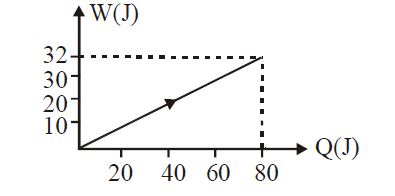
In the figure shown, amount of heat supplied to one mole of an ideal gas is plotted on the horizontal axis and amount of work done by gas is drawn on vertical axis. Assuming process be isobaric i.e. gas can be 
When $100\,g$ of a liquid $A$ at $100\,^oC$ is added to $50\,g$ of a liquid $B$ at temperature $75\,^oC$, the temperature of the mixture becomes $90\,^oC$. The temperature of the mixture, if $100\,g$ of liquid $A$ at $100\,^oC$ is added to $50\,g$ of liquid $B$ at $50\,^oC$, will be ........$^oC$
If the gravitational field in the space is given as $\left(-\frac{ K }{ r ^2}\right)$. Taking the reference point to be at $r =2\,cm$ with gravitational potential $V =10\,J / kg$. Find the gravitational potential at $r =3\,cm$ in $SI$ unit (Given, that $K =6\,J cm / kg$ )
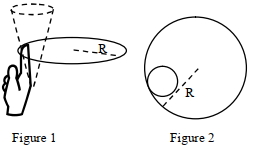
One twirls a circular ring (of mass $M$ and radius $R$ ) near the tip of one's finger as shown in Figure $1$ . In the process the finger never loses contact with the inner rim of the ring. The finger traces out the surface of a cone, shown by the dotted line. The radius of the path traced out by the point where the ring and the finger is in contact is $\mathrm{r}$. The finger rotates with an angular velocity $\omega_0$. The rotating ring rolls without slipping on the outside of a smaller circle described by the point where the ring and the finger is in contact (Figure $2$). The coefficient of friction between the ring and the finger is $\mu$ and the acceleration due to gravity is $g$.

(IMAGE)

($1$) The total kinetic energy of the ring is

$[A]$ $\mathrm{M} \omega_0^2 \mathrm{R}^2$   $[B]$ $\frac{1}{2} \mathrm{M} \omega_0^2(\mathrm{R}-\mathrm{r})^2$   $[C]$ $\mathrm{M \omega}_0^2(\mathrm{R}-\mathrm{r})^2$   $[D]$ $\frac{3}{2} \mathrm{M} \omega_0^2(\mathrm{R}-\mathrm{r})^2$

($2$) The minimum value of $\omega_0$ below which the ring will drop down is

$[A]$ $\sqrt{\frac{g}{\mu(R-r)}}$  $[B]$ $\sqrt{\frac{2 g}{\mu(R-r)}}$  $[C]$ $\sqrt{\frac{3 g}{2 \mu(R-r)}}$    $[D]$ $\sqrt{\frac{g}{2 \mu(R-r)}}$

Givin the answer quetion ($1$) and ($2$)
A block of mass $m$ is on an inclined plane of angle $\theta$. The coefficient of friction between the block and the plane is $\mu$ and $\tan \theta>\mu$. The block is held stationary by applying a force $\mathrm{P}$ parallel to the plane. The direction of force pointing up the plane is taken to be positive. As $\mathrm{P}$ is varied from $\mathrm{P}_1=$ $m g(\sin \theta-\mu \cos \theta)$ to $P_2=m g(\sin \theta+\mu \cos \theta)$, the frictional force $f$ versus $P$ graph will look like
A car travels a distance of $x$ with speed $v_1$ and then same distance $x$ with speed $v_2$ in the same direction. The average speed of the car is