MCQ
The time period of the pendulum hanging from the roof of a stationary vehicle is T. When the car accelerates with uniform acceleration then the time period :
  • A
    will increase
  • will decrease
  • C
    will be unaffected
  • D
    will become infinite

Answer

Correct option: B.
will decrease
(B)

Need a full question paper?

Generate a complete, print-ready paper with questions like this in minutes — across 16+ boards, with answer keys.
Start Generating Free

Similar questions

A diatomic gas undergoes a process represented by $PV ^{1.3}=$ constant. Choose the incorrect statement
A ball thrown by one player reaches the other in $2$ sec. the maximum height attained by the ball above the point of projection will be about ....... $m$
A body is thrown vertically upwards with velocity $u$. The distance travelled by it in the fifth and the sixth seconds are equal. The velocity $u$ is given by.........$m/s$ ($g = 9.8\, m/s^{2}$)
Water rises to a height $h$ in capillary tube. If the length of capillary tube above the surface of water is made less than $h,$ then
Two bodies of mass $4 \mathrm{~g}$ and $25 \mathrm{~g}$ are moving with equal kinetic energies. The ratio of magnitude of their linear momentum is :
A pressure-pump has a horizontal tube of cross-sectional area $10\,cm ^{2}$ for the outflow of water at a speed of $20\,m / s$. The force exerted on the vertical wall just in front of the tube which stops water horizontally flowing out of the tube, is $...N$ [given : density of water $=1000\,kg / m ^{3}$ ]
Earth is revolving around the sun if the distance of the Earth from the Sun is reduced to $\frac{1}{4}^{th}$ of the present distance then the present day length reduced by
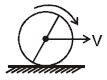
$A$ ring of mass $m$ is rolling without slipping with linear velocity $v$ as shown is figure. $A$ rod of identical mass is fixed along one of its diameter. The total kinetic energy of the system is :-
Two forces having magnitude $A$ and $\frac{ A }{2}$ are perpendicular to each other. The magnitude of their resultant is
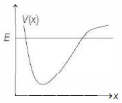
Consider a one-dimensional potential $V(x)$ as shown in the figure below. A classical particle of mass $m$ moves under its influence and has total energy $E$ as shown below. The motion is