Question
The torque of a force $\overrightarrow{\text{F}}$ about a point is defined as $\overrightarrow{\text{r}}=\overrightarrow{\text{r}}\times\overrightarrow{\text{F}}.$ Suppose $\overrightarrow{\text{r}}, \overrightarrow{\text{F}}$and $\overrightarrow{\text{r}}$ are all nonzero. Is $\text{r}\times\overrightarrow{\text{r}}\Bigg|\Bigg|\overrightarrow{\text{F}}$ always true? Is it ever true?
Answer

No, $\overrightarrow{\text{r}}\times\overrightarrow{\text{r}}\Bigg|\Bigg|\overrightarrow{\text{r}}$ is not true. In fact, it is never true. This is because:$\overrightarrow{\text{r}}\times\overrightarrow{\text{r}}$
$=\overrightarrow{\text{r}}\times\Big(\overrightarrow{\text{r}}\times\overrightarrow{\text{F}}\Big)$
Applying vector triple product, we get:$\overrightarrow{\text{r}}\times\Big(\overrightarrow{\text{r}}\times\overrightarrow{\text{F}}\Big)$
$=\Big(\overrightarrow{\text{r}}.\overrightarrow{\text{F}}\Big)\overrightarrow{\text{r}}-\Big(\overrightarrow{\text{r}}.\overrightarrow{\text{r}}\Big)\overrightarrow{\text{F}}$
$\because\overrightarrow{\text{r}}.\overrightarrow{\text{r}}=\text{r}^2$
$=\Big(\overrightarrow{\text{r}}.\overrightarrow{\text{F}}\Big)\overrightarrow{\text{r}}-\text{r}^2\overrightarrow{\text{F}}$
If $\overrightarrow{\text{r}}.\overrightarrow{\text{F}}=0;$ that is, $\overrightarrow{\text{r}}\perp\overrightarrow{\text{F}},$ then:$\overrightarrow{\text{r}}\times\overrightarrow{\text{r}}=-\text{r}^2.\overrightarrow{\text{F}}$
We know that $r^2$ is never negative and $\overrightarrow{\text{r}}\times\overrightarrow{\text{r}}=-\text{r}^2.\overrightarrow{\text{F}}$ This implies that both vectors may be antiparallel to each other but not parallel.

Need a full question paper?

Generate a complete, print-ready paper with questions like this in minutes — across 16+ boards, with answer keys.

Start Generating Free

Similar questions

Find the moment of inertia of a pair of spheres, each having a mass m and radius r, kept in contact about the tangent passing through the point of contact.
The force on a charged particle due to electric and magnetic fields is given by $\overrightarrow{\text{F}}=\text{q}\overrightarrow{\text{E}}+\text{q}\overrightarrow{\text{v}}\times\overrightarrow{\text{B}}.$ Suppose $\overrightarrow{\text{E}}$ is along the X-axis and $\overrightarrow{\text{B}}$ along the Y-axis. In what direction and with what minimum speed v should a positively charged particle be sent so that the net force on it is zero?
It is proposed to move a particle in simple harmonic motion on a rough horizontal surface by applying an external force along the line of motion. Sketch the graph of the applied force against the position of the particle. Note that the applied force has two values for a given position depending on whether the particle is moving in positive or negative direction.
A light ray is refracted from medium $(1)$ to medium $(2).$ Their refractive indices are $n_1$ and $n_2,$ respectively and $n_2 < n_1.$ Write an expression for the critical angle of incidence.
X-rays of wavelength $'\lambda'$ fall on a photosensitive surface, emitting electrons. Assuming that the work function of the surface can be neglected, prove that the de Broglie wavelength of electrons emitted will be $\sqrt{\frac{\text{h}\gamma}{2\text{mc}}}.$
An electric current of 5 A is flowing through a wire of area of cross-section $4 \times 10^{-6} m^2$. If the number density of charge carriers (free electrons) is $5 \times 10^{26}$ $m ^{-3}$. Find the drift velocity of the electrons.
The ground state energy of hydrogen atom is – 13·6 eV. If an electron makes a transition from an energy level – 1·51 eV to – 3·4 eV, calculate the wavelength of the spectral line emitted and name the series of hydrogen spectrum to which it belongs.
Draw a graph between photoelectric current and anode potential for two light beams of different intensity and same wavelength.
Draw the graph between the frequency of the incident light and the stopping potential in the experiment of photoelectric.

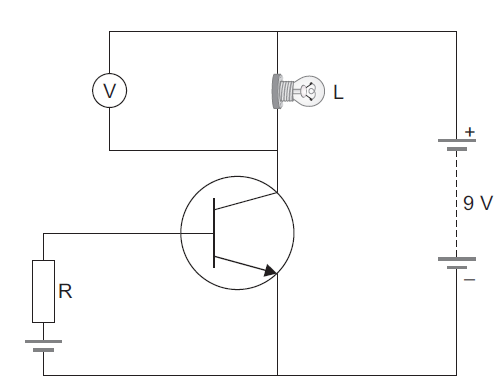
In the given circuit diagram, a voltmeter ‘V’ is connected aross a lamp ’L’. How would (i) the brightness of the lamp and (ii) voltmeter reading ‘V’ be affected, if the value of resistance ‘R’ is decreased? Justify your answer.