MCQ
The total number of acylic isomers including the stereoisomers with the molecular formula ${C_4}{H_7}Cl$
- A$11$
- ✓$12$
- C$9$
- D$10$
$(i)$ $C{H_3} - C{H_2} - CH = C{H_2}$ : Its possible mono-chloro derivatives are :
$C{H_3} - C{H_2} - CH = CH - Cl$
$2$ isomers : cis and trans forms
$C{H_3} - \mathop {\mathop {\mathop C\limits^ \bullet }\limits_| H}\limits_{Cl\;} - CH = C{H_2}$
optically active (exists in two forms)
$ClC{H_2} - C{H_2} - CH = C{H_2}$ (one form)
${H_3}C - C{H_2} - \mathop {\mathop C\limits^| = }\limits^{Cl\;} C{H_2}$ (one form)
$(ii)$ $C{H_3} - CH = CH - C{H_3}$ : Its possible monochloro derivatives are :
$C{H_3} - CH = \mathop {\mathop C\limits_| - }\limits_{Cl\;} C{H_3}$
Exists in two geometrical forms
$C{H_3} - CH = CH - C{H_2}Cl$
Exists in two geometrical forms
$(iii)$ $\begin{array}{*{20}{c}}
{C{H_3} - C = C{H_2}} \\
{\,|\,\,} \\
{\,\,\,C{H_3}}
\end{array}$ : Its possible monochloro derivatives are
$\begin{array}{*{20}{c}}
{C{H_3} - C = CH - Cl} \\
{|\,\,\,\,\,\,\,\,\,\,} \\
{C{H_{3\,\,\,\,\,\,\,\,}}}
\end{array}$
Only one form
$\begin{array}{*{20}{c}}
{ClC{H_2} - C = C{H_2}} \\
{\,\,\,|} \\
{\,\,\,\,\,\,C{H_3}}
\end{array}$
Only one form
Thus, the total acylic isomers forms of ${C_4}{H_7}Cl$ are $12$.
Generate a complete, print-ready paper with questions like this in minutes — across 16+ boards, with answer keys.
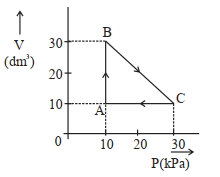
An ideal gas undergoes a cyclic transformation starting from the point $\mathrm{A}$ and coming back to the same point by tracing the path $\mathrm{A} \rightarrow \mathrm{B} \rightarrow \mathrm{C} \rightarrow \mathrm{A}$ as shown in the diagram. The total work done in the process is____ $J$.