MCQ
The transition metal ions responsible for colour in ruby and emerald are, respectively
  • A
    $Co^{3+}$ and $Cr^{3+}$
  • B
    $Co^{3+}$ and $Co^{3+}$
  • $Cr^{3+}$ and $Cr^{3+}$
  • D
    $Cr^{3+}$ and $Co^{3+}$

Answer

Correct option: C.
$Cr^{3+}$ and $Cr^{3+}$
c
A ruby is a crystal of alumina, aluminum oxide $(Al_2O_3)$ containing a trace of chromium $(III)$ ions replacing some of the aluminum ions. In ruby, each $Al^{3+}$ ion and $Cr^{3+}$ ion is surrounded by six oxide ions in an octahedral arrangement. The origin of the color of emeralds is similar to that of the color of rubies. However, the bulk of an emerald crystal is composed of beryl, beryllium aluminum silicate $(Be_3 Al_2(SiO_3)_6)$ instead of the alumina which forms rubies. The color is produced by chromium $(III)$ ions, which replace some of the aluminum ions in the crystal. In emeralds, the $Cr^{3+}$ is surrounded by six silicate ions, rather than the six oxide ions in ruby. Therefore, the color (green) of emeralds is different from that of ruby

Need a full question paper?

Generate a complete, print-ready paper with questions like this in minutes — across 16+ boards, with answer keys.

Start Generating Free

Similar questions

Among $\left[\mathrm{Ni}(\mathrm{CO})_4\right],\left[\mathrm{NiCl}_4\right]^{2-},\left[\mathrm{Co}\left(\mathrm{NH}_3\right)_4 \mathrm{Cl}_2\right] \mathrm{Cl}, \mathrm{Na}_3\left[\mathrm{CoF}_6\right], \mathrm{Na}_2 \mathrm{O}_2$ and $\mathrm{CsO}_2$, the total number of paramagnetic compounds is
Chemical property of $Li$ and $Mg$ are similar because
Which of the following is liquid at room temperature
The standard oxidation potential of zinc and silver in water at  $298\,K$ are $Zn\,\,(s)\,\, \to \,\,Z{n^{2 + }} + 2{e^ - }\,;\,E = 0.76\,V$ 

$Ag\,\,(s)\,\, \to \,A{g^{2 + }} + 2{e^ - }\,;\,E =  - 0.80\,V$  Which of the following reactions actually take place

Which two orbital are located along the axis and not between the axis ?
Given $E^o _{Cr^{3+} / Cr} = - 0.72\, V, \,$$E^o _{Fe^{2+} / Fe} =-0.42 \,V.$ The potential for the cell

$Cr\, | \,Cr^{3+}_{(0.1\,M)}\,||\, Fe^{2+}_{(0.01\, M)}\,|\, Fe$ is ......... $V$

Select correct about the following change

$NO_2^+ \to NO_2 \to NO_2^-$

Total number of compounds with Chiral carbon atoms from following is___________.   $IMAGE$

$ \mathrm{CH}_3-\mathrm{CH}_2-\mathrm{CH}\left(\mathrm{NO}_2\right)-\mathrm{COOH} $

$ \mathrm{CH}_3-\mathrm{CH}_2-\mathrm{CHBr}-\mathrm{CH}_2-\mathrm{CH}_3 $

$ \mathrm{CH}_3-\mathrm{CH}(\mathrm{I})-\mathrm{CH}_2-\mathrm{NO}_2 $

$ \mathrm{CH}_3-\mathrm{CH}_2-\mathrm{CH}(\mathrm{OH})-\mathrm{CH}_2 \mathrm{OH} $

$ \mathrm{CH}_3-\mathrm{CH}-\mathrm{CH}(\mathrm{I})-\mathrm{C}_2 \mathrm{H}_5 $
Pauli's exclusion principle states that
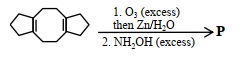
In the reaction given below, the total number of atoms having $s p^2$ hybridization in the major product $P$ is. . . . .