MCQ
The transverse displacement of a string $($clamped at its both ends$)$ is given by $\text{y}(\text{x, t})=0.06\sin(1\pi\text{x/ 3})\cos(120\pi\text{t}).$
All the points on the string between two consecutive nodes vibrate with
  • A
    Same frequency.
  • B
    Same phase.
  • C
    Different amplitude.
  • All of the above

Answer

Correct option: D.
All of the above
The frequencies of all particles are same, verifies the option $(a).$
particles between any two consecutive nodes vibrates either upside or downside having sameb phase $120\pi\text{t}$ any time, verifies the option $(b)$
particles have ditternt energies. so rejects the option $(c)$
As the amplitude of different particles are diffrent between two nodes energy $(E) \propto\text{A}^2.$ 

Need a full question paper?

Generate a complete, print-ready paper with questions like this in minutes — across 16+ boards, with answer keys.

Start Generating Free

Similar questions

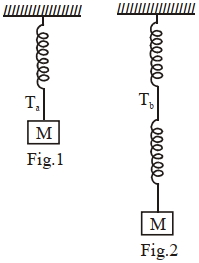
Consider two identical springs each of spring constant $k$ and negligible mass compared to the mass $M$ as shown. Fig. $1$ shows one of them and Fig. $2$ shows their series combination. The ratios of time period of oscillation of the two $SHM$ is $\frac{ T _{ b }}{ T _{ a }}=\sqrt{ x },$ where value of $x$ is

(Round off to the Nearest Integer)

Consider two satellites $S_{1}$ and $S_{2}$ with periods of revolution $1\, hr$. and $8\, hr$. respectively revolving around a planet in circular orbits. The ratio of angular velocity of satellite $S_{1}$ to the angular velocity of satellites $S _{2}$ is
Equal volumes of two gases at the same temperature and pressure have the same:
In a vessel equal masses of alcohol (sp. gravity $0.8$ ) and water are mixed together. A capillary tube of radius $1\,mm$ is dipped vertically in it. If the mixture rises to a height $5\,cm$ in the capillary tube, the surface tension of the mixture is ....... $dyne/cm$
Two bodies of equal masses revolve in circular orbits of radii ${R_1}$ and ${R_2}$ with the same period. Their centripetal forces are in the ratio
The law of partial pressure of gases was given by:
A steel rod of length $1m$ and radius $10mm$ is stretched by a force $100kN$ along its length. The stress produced in the rod is $Y_{steel} = 2 \times 10^{11}Nm^{-2}$.
If radius of the earth contracts $2\%$ and its mass remains the same, then weight of the body at the earth surface
An object is projected with a velocity of $20 m/s$ making an angle of $45^o$ with horizontal. The equation for the trajectory is $h = Ax -Bx^2$ where $h$ is height, $x$ is horizontal distance, $A$ and $B$ are constants. The ratio $A : B$ is ($g = 10 ms^{-2}$)
Two particles are performing simple harmonic motion in a straight line about the same equilibrium point. The amplitude and time period for both particles are same and equal to $A$ and $T,$  respectively. At time $t=0$ one particle has displacement $A$ while the other one has displacement $\frac {-A}{2}$ and they are moving towards each other. If they cross each other at time $t,$ then $t$ is