MCQ
The transverse displacement $y(x, t)$ of a wave on a string is given by $y(x, t)=e^{-\left(a x^2+b t^2+2 \sqrt{a b} x t\right)}$ This represents a
  • wave moving in $-x$ direction, speed $\sqrt{\frac{b}{a}}$
  • B
    standing wave of frequency $\sqrt{b}$
  • C
    standing wave of frequency $\frac{1}{\sqrt{b}}$
  • D
    wave moving in $+x$ direction, speed $\sqrt{\frac{a}{b}}$
Answer

Correct option: A.
wave moving in $-x$ direction, speed $\sqrt{\frac{b}{a}}$
a
(a)

$y(x, t)=e^{-\left(a x^2+b t^2+2 \sqrt{a b} x t\right)}=e^{-(\sqrt{a} x+\sqrt{b} t)^2}$

It is a function of type

$y=f(\omega t+k x)$

$\therefore y(x, t)$ represents wave travelling along

$-x$ direction.

Speed of wave $=\frac{\omega}{k}=\frac{\sqrt{b}}{\sqrt{a}}=\sqrt{\frac{b}{a}}$.

Need a full question paper?

Generate a complete, print-ready paper with questions like this in minutes — across 16+ boards, with answer keys.

Start Generating Free

Similar questions

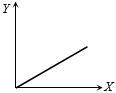
A student plots a graph from his reading on the determination of Young’s modulus of a metal wire but forgets to label. The quantities on $X$ and $Y$ axes may be respectively.
A mass $M$ is suspended from a spring of negligible mass. The spring is pulled a little and then released so that the mass executes $S.H.M.$ of time period $T$. If the mass is increased by m, the time period becomes $5T/3$. Then the ratio of $m/M$ is
A body having its centre of mass at the origin has three of its particles at $(a, 0,0),(0, a, 0),(0,0, a)$. The moments of inertia of the body about the $X$ and $Y$ axes are $0.20 \mathrm{~kg}-\mathrm{m}^2$ each. The moment of inertia about the $Z-$axis:
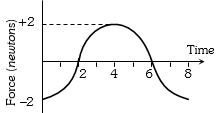
A force-time graph for a linear motion is shown in figure where the segments are circular. The linear momentum gained between zero and $8$ second is
Let $[{\varepsilon _0}]$ denotes the dimensional formula of the permittivity of the vacuum and $[{\mu _0}]$ that of the permeability of the vacuum. If $M = {\rm{mass}}$, $L = {\rm{length}}$, $T = {\rm{Time}}$ and $I = {\rm{electric current}}$, then
The projection of a vector $\vec r\, = \,3\hat i\, + \,\hat j\, + \,2\hat k$ on the $xy$ plane has magnitude
An ideal gas follows a process described by $p V^2=C$ from $\left(p_1, V_1, T_1\right)$ to $\left(p_2, V_2, T_2\right)$ and $C$ is a constant. Then,
A disc of mass $3 \,kg$ rolls down an inclined plane of height $5 \,m$. The translational kinetic energy of the disc on reaching the bottom of the inclined plane is .......... $J$
Let us consider a system of units in which mass and angular momentum are dimensionless. If length has dimension of $L$, which of the following statement ($s$) is/are correct ?

$(1)$ The dimension of force is $L ^{-3}$

$(2)$ The dimension of energy is $L ^{-2}$

$(3)$ The dimension of power is $L ^{-5}$

$(4)$ The dimension of linear momentum is $L ^{-1}$

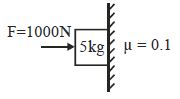
For the given figure, if block remains in equilibrium position then find frictional force between block and wall ........ $N$