MCQ
The transverse nature of light is shown by
  • A
    Interference of light
  • B
    Refraction of light
  • Polarization of light
  • D
    Dispersion of light

Answer

Correct option: C.
Polarization of light
c

Need a full question paper?

Generate a complete, print-ready paper with questions like this in minutes — across 16+ boards, with answer keys.
Start Generating Free

Similar questions

A vessel contain a liquid has a constant acceleration $19.6 \,m / s ^2$ in horizontal direction. The free surface of water get sloped with horizontal at angle .......... 
Two coherent sources of intensity ratio $\alpha$ interfere. The value of $\frac{{{I_{max}} - {I_{min}}}}{{{I_{max}} + {I_{min}}}}$ is
The colour of the positive column in a gas discharge tube depends on
A simple pendulum with a metallic bob has a time period $T$. The bob is now immersed in a non-viscous liquid and oscillated. If the density of the liquid is $1 / 4$ that of metal, the time period of the same pendulum will be ...........
The clocktower ("ghantaghar") of Dehradun is famous for the sound of its bell, which can be heard, albeit faintly, upto the outskirts of the city $8 \,km$ away. Let the intensity of this faint sound be $30 \,dB$. The clock is situated $80 \,m$ high. The intensity at the base of the tower is .............$\,dB$
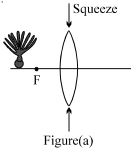
$A$ turnip sits before a thin converging lens, outside the focal point of the lens. The lens is filled with a transparent gel so that it is flexible; by squeezing its ends toward its center [as indicated in figure $(a)$], you can change the curvature of its front and rear sides. When you squeeze the lens, the image.
A particle of mass $m_1$ is moving with a velocity $v_1$ and another particle of mass $m_2$ is moving with a velocity $v_2$ . Both of them have the same momentum but their different kinetic energies are $E_1$ and $E_2$ respectively. If $m_1 > m_2$ then
If $2.5 \times 10^{-6\,} N$ average force is exerted by a light wave on a non-reflecting surface of $30\, cm ^{2}$ area during $40$ minutes of time span, the energy flux of light just before it falls on the surface is .................. $W / cm ^{2}$

(Round off to the Nearest Integer)

(Assume complete absorption and normal incidence conditions are there)
If one mole of the polyatomic gas is having two vibrational modes and $\beta$ is the ratio of molar specific heats for polyatomic gas $\left(\beta=\frac{ C _{ P }}{ C _{ v }}\right)$ then the value of $\beta$ is: