Question
The transverse nature of light is shown by:

Answer

  1. Polarization of light
Explanation:
Polarisation of light establishes that light are transverse in nature, otherwise it was believed that they are longitudinal waves, like the sound waves.

Need a full question paper?

Generate a complete, print-ready paper with questions like this in minutes — across 16+ boards, with answer keys.
Start Generating Free

Similar questions

The ratio of the frequencies of the long wavelength limits of Lyman and Balmer series of hydrogen spectrum is(a) 27 : 5 (b) 5 : 27(c) 4 : 1(d) 1 : 4
       
The tangent galvanometer, when connected in series with a standard resistance can be used as(a) An ammeter(b) A voltmeter(c) A wattmeter(d) Both an ammeter and a voltmeter
   
   
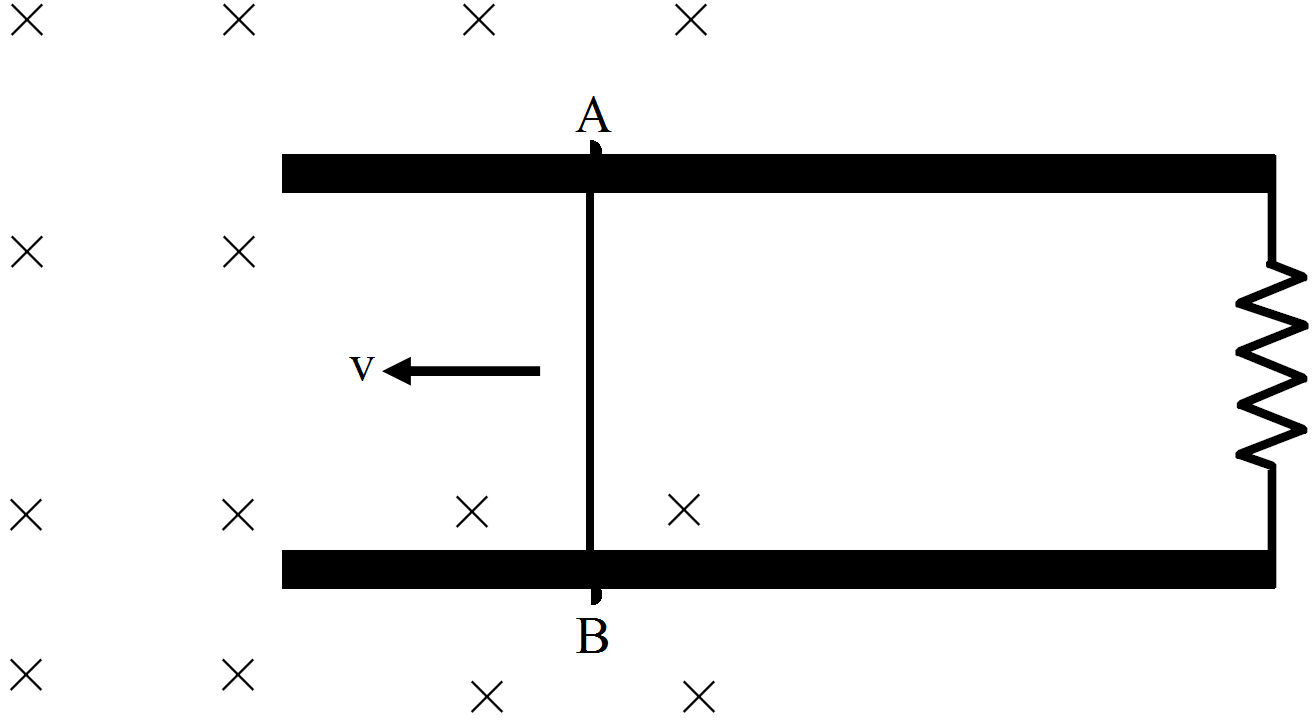
Consider the situation shown in figure. The wire AB is slid on the fixed rails with a constant velocity. If the wire AB is replaced by a semicircular wire, the magnitude of the induced current will: 
Two photons, each of energy 2.5 eV are simultaneously incident on the metal surface. If the work function of the metal is 4.5 eV, then from the surface of the metal:
X-rays are not used for radar purpose because(a) They are not reflected by the target(b) They are not electromagnetic waves(c) They are completely absorbed by the air(d) They sometimes damage the target


The displacement current was first populated by.
If work function of metal is 3eV then threshold wavelength will be(a) 4125 Å(b) 4000 Å(c) 4500 Å(d) 5000 Å
       
Assertion  : Radio waves can be polarised.
Reason     : Sound waves in air are longitudinal in nature. (a) If both assertion and reason are true and the reason is the correct explanation of the assertion.(b) If both assertion and reason are true but reason is not the correct explanation of the assertion.(c) If assertion is true but reason is false.(d) If the assertion and reason both are false.


The resultant of $\overrightarrow{\text{A}}$ and $\overrightarrow{\text{B}}$ makes an angle a with $\overrightarrow{\text{A}}$ and $\beta$ with $\overrightarrow{\text{B}},$
  1. $\alpha<\beta$
  2. $\alpha<\beta \text{ if}\text{ A}<\text{B}$
  3. $\alpha<\beta \text{ if}\text{ A}>\text{B}$
  4. $\alpha<\beta \text{ if}\text{ A}=\text{B}$
The rate of disintegration at a given instant, is directly proportional to the number of atoms present at that instant. This is the statement of: