MCQ
The triangle formed by ${x^2} - 9{y^2} = 0$ and $x = 4$ is
  • Isosceles
  • B
    Equilateral
  • C
    Right angled
  • D
    None of these

Answer

Correct option: A.
Isosceles
a
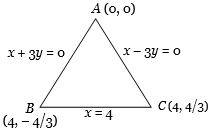
(a) Given lines are ${x^2} - 9{y^2} = 0$ and $x = 4$.

We have ${x^2} - 9{y^2} = 0$

So equation of line is,

$x - 3y = 0$.....$(i)$

$x + 3y = 0$.....$(ii)$

$x = 4$.....$(iii)$

By solving $(i)$, $(ii)$ and $(iii)$ we get

$A(0,\,0),\,\,B\,\left( {4,\,\frac{{ - 4}}{3}} \right),\,\,C\,\left( {4,\,\frac{4}{3}} \right)$

Now, $AB = \sqrt {{{(4 - 0)}^2} + {{\left( {0 + \frac{4}{3}} \right)}^2}} = \frac{{4\sqrt {10} }}{3}$

$AC = \sqrt {{{(4 - 0)}^2} + {{\left( {0 - \frac{4}{3}} \right)}^2}} = \frac{{4\sqrt {10} }}{3}$

$BC = \sqrt {{{(4 - 4)}^2} + {{\left( {\frac{4}{3} + \frac{4}{3}} \right)}^2}} = \frac{8}{3}$

Hence $ABC$ is an isosceles triangle.
Need a full question paper?

Generate a complete, print-ready paper with questions like this in minutes — across 16+ boards, with answer keys.

Start Generating Free

Similar questions

Solution of the differential equation $\cos x\;dy = y\left( {\sin x - y} \right)dx,0 < x < \frac{\pi }{2}$ is
The angle between the tangents drawn at the end points of the latus rectum of parabola ${y^2} = 4ax$, is
If the letters of the word $MATHS$ are permuted and all possible words so formed are arranged as in a dictionary with serial numbers, then the serial number of the word $THAMS$ is
Given vertices $A(1,\,1),B(4,\, - 2)$ and $C(5,\,5)$ of a triangle, then the equation of the perpendicular dropped from $C$ to the interior bisector of the angle $A$ is
The value of $\sin 10^\circ + \sin 20^\circ + \sin 30^\circ + ... + $ $\sin 360^\circ $ is
The value of $\int_0^\pi {{e^{{{\cos }^2}x}}{{\cos }^5}3x} \,dx$ is
A circle $C$ of radius $1$ is inscribed in an equilateral triangle $P Q R$. The points of contact of $C$ with the sides $P Q, Q R, R P$ are $D, E, F$, respectively. The line $P Q$ is given by the equation $\sqrt{3} x+y-6=0$ and the point $D$ is $\left(\frac{3 \sqrt{3}}{2}, \frac{3}{2}\right)$. Further, it is given that the origin and the centre of $\mathrm{C}$ are on the same side of the line $\mathrm{PQ}$.

$1.$  The equation of circle $\mathrm{C}$ is

$(A)$ $(x-2 \sqrt{3})^2+(y-1)^2=1$

$(B)$ $(x-2 \sqrt{3})^2+\left(y+\frac{1}{2}\right)^2=1$

$(C)$ $(x-\sqrt{3})^2+(y+1)^2=1$

$(D)$ $(x-\sqrt{3})^2+(y-1)^2=1$

$2.$  Points $E$ and $F$ are given by

$(A)$ $\left(\frac{\sqrt{3}}{2}, \frac{3}{2}\right),(\sqrt{3}, 0)$

$(B)$ $\left(\frac{\sqrt{3}}{2}, \frac{1}{2}\right),(\sqrt{3}, 0)$

$(C)$ $\left(\frac{\sqrt{3}}{2}, \frac{3}{2}\right),\left(\frac{\sqrt{3}}{2}, \frac{1}{2}\right)$

$(D)$ $\left(\frac{3}{2}, \frac{\sqrt{3}}{2}\right),\left(\frac{\sqrt{3}}{2}, \frac{1}{2}\right)$

$3.$  Equation of the sides $Q R, R P$ are

$(A)$ $y=\frac{2}{\sqrt{3}} x+1, y=-\frac{2}{\sqrt{3}} x-1$

$(B)$ $y=\frac{1}{\sqrt{3}} x, y=0$

$(C)$ $y=\frac{\sqrt{3}}{2} x+1, y=-\frac{\sqrt{3}}{2} x-1$

$(D)$ $y=\sqrt{3} x, y=0$

Give the answer question $1,2$ and $3.$

The distance between the directrices of the ellipse $\frac{{{x^2}}}{{36}} + \frac{{{y^2}}}{{20}} = 1$ is
The point $(0.1, 3.1)$ with respect to the circle ${x^2} + {y^2} - 2x - 4y + 3 = 0$, is
If the set $R=\{(a, b) ; a+5 b=42, a, b \in \mathbb{N}\}$ has $m$ elements and $\sum_{n=1}^m\left(1+i^{n !}\right)=x+i y$, where $I=\sqrt{-1}$, then the value of $m+x+y$ is :