Question
The triode constant is out of the following

Answer

Triode, electron tube consisting of three electrodes-cathode filament, anode plate, and control grid-mounted in an evacuated metal or glass container. It has been used as an amplifier for both audio and radio signals, as an oscillator, and in electronic circuits.

Need a full question paper?

Generate a complete, print-ready paper with questions like this in minutes — across 16+ boards, with answer keys.
Start Generating Free

Similar questions

One gram mole of an ideal gas $A$ with the ratio of constant pressure and constant volume specific heats $\gamma_{A}=5 / 3$ is mixed with $n$ gram moles of another ideal gas $B$ with $\gamma_{B}=7 / 5$. If the $\gamma$ for the mixture is $19 / 13$, then what will be the value of $n$ ?
The wavelength of ultrasonic waves in air is of the order of
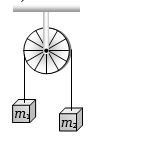
Two masses ${m_1}$ and ${m_2}$ are attached to a string which passes over a frictionless smooth pulley. When ${m_1} = 10kg,$ ${m_2} = 6kg,\,$the acceleration of masses is  .......... $m/s^{2}$
A closed organ pipe and an open pipe of same length produce $4$ beats when they are set into vibrations simultaneously. If the length of each of them were twice their initial lengths, the number of beats produced will be
Maximum useable frequency $(MUF)$ in $F$ -region layer is $x$ , when the critical frequency is $60 \,MHz$ and the angle of incidence is $70°$. Then $x$ is.......$MHz$
A heavy box of $40\, kg$ is pushed along $20\, m$ by two coolies over a railway platform  whose coefficient of friction with the box is $0.4.$ The work done by two coolies is :- .................. $\mathrm{J}$
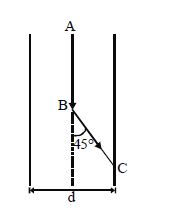
A sphere carrying charge of $Q$ having weight $w$ falls under gravity between a pair of vertical plates at a distance of $d$ from each other. When a potential difference $V$ is applied between the plates the acceleration of sphere changes as shown in the figure, to along line $BC$. The value of $Q$ is :-
A conducting metal circular-wire-loop of radius $r$ is placed perpendicular to a magnetic field which varies with time as $B = {B_0}{e^{\frac{{ - t}}{\tau }}}$ , where $B_0$ and $\tau $ are constants, at time $t = 0$. If the resistance of the loop is $R$ then the heat generated in the loop after a long time $\left( {t \to \infty } \right)$ is
An electron is moving along $+x$ direction with a velocity of $6 \times 10^{6}\, ms ^{-1}$. It enters a region of uniform electric field of $300 \,V / cm$ pointing along $+ y$ direction. The magnitude and direction of the magnetic field set up in this region such that the electron keeps moving along the $x$ direction will be
A particle of mass $M=0.2 kg$ is initially at rest in the $x y$-plane at a point $( x =-l, y =-h)$, where $l=10 m$ and $h=1 m$. The particle is accelerated at time $t =0$ with a constant acceleration $a =10 m / s ^2$ along the positive $x$-direction. Its angular momentum and torque with respect to the origin, in SI units, are represented by $\vec{L}$ and $\vec{\tau}$, respectively. $\hat{i}, \hat{j}$ and $\hat{k}$ are unit vectors along the positive $x , y$ and $z$-directions, respectively. If $\hat{k}=\hat{i} \times \hat{j}$ then which of the following statement($s$) is(are) correct?

$(A)$ The particle arrives at the point $(x=l, y=-h)$ at time $t =2 s$.

$(B)$ $\vec{\tau}=2 \hat{ k }$ when the particle passes through the point $(x=l, y=-h)$

$(C)$ $\overrightarrow{ L }=4 \hat{ k }$ when the particle passes through the point $(x=l, y=-h)$

$(D)$ $\vec{\tau}=\hat{ k }$ when the particle passes through the point $(x=0, y=-h)$