MCQ
The trivalent ion having largest size in following is
  • A
    $Ti$
  • B
    $Zr$
  • C
    $Hf$
  • $La$

Answer

Correct option: D.
$La$
d
The Lanthanide series starts from $La$ and thus $La ^{3+}$ will have the largest size because we know on moving across the period from left to right the size decreases in Lanthanide and thus the same will be similar for the trivalent ions.

Need a full question paper?

Generate a complete, print-ready paper with questions like this in minutes — across 16+ boards, with answer keys.

Start Generating Free

Similar questions

Which of the following does not have a metal carbon bond
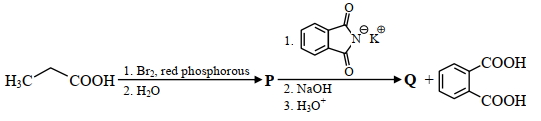
Considering the reaction sequence given below, the correct statement($s$) is(are)

$(A)$ $P$ can be reduced to a primary alcohol using $NaBH _4$.

$(B)$ Treating $P$ with conc. $NH _4 OH$ solution followed by acidification gives $Q$.

$(C)$ Treating $Q$ with a solution of $NaNO _2$ in aq. $HCl$ liberates $N _2$.

$(D)$ $P$ is more acidic than $CH _3 CH _2 COOH$.
Sulphur in $+3$ oxidation state is present in
The correct statement$(s)$ regarding, $(i)$ $HC1O$, $(ii)$ $HClO _2$, $(iii)$ $HClO _3$ and $(iv)$ $HClO _4$, is (are)

$(A)$ The number of $Cl = O$ bonds in $(ii)$ and $(iii)$ together is two

$(B)$ The number of lone pairs of electrons on $Cl$ in $(ii)$ and $(iii)$ together is three

$(C)$ The hybridization of $Cl$ in $(iv)$ is $sp ^3$

$(D)$ Amongst $(i)$ to $(iv)$, the strongest acid is $(i)$

Which reaction does not produce ammonia?
A first order reaction with respect to the reactant $A $ has a rate constant of $6\;{\sec ^{ - 1}}$. If we start with $[A] = 0.5 $ $mol/litre$, then in what time the concentration of $A$  becomes $0.05 $ $mol/litre$ ........... $\sec$
Among the following which one is a wrong statement?
Concentrated $HN{O_3}$ reacts with ${I_2}$ to give
The higher oxidation states of transition elements are found to be in the combination with $A$ and $B,$ which are
Osmotic pressure of a $4.44\%$ solution of anhydrous $CaCl_2$ was found to be $16.42\ atm$ at $27\,^oC$. What is the degree of dissociation of $CaCl_2$ in $ . . . . ... \%$ :