MCQ
The truth table for this gvien circuit is:
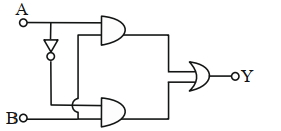
  • A
    $A$ $B$ $Y$
    $0$ $0$ $1$
    $0$ $1$ $1$
    $1$ $0$ $1$
    $1$ $1$ $0$
  • $A$ $B$ $Y$
    $0$ $0$ $0$
    $0$ $1$ $1$
    $1$ $0$ $0$
    $1$ $1$ $1$
  • C
    $A$ $B$ $Y$
    $0$ $0$ $0$
    $0$ $1$ $0$
    $1$ $0$ $0$
    $1$ $1$ $1$
  • D
    $A$ $B$ $Y$
    $0$ $0$ $1$
    $0$ $1$ $0$
    $1$ $0$ $1$
    $1$ $1$ $0$
Answer

Correct option: B.
$A$ $B$ $Y$
$0$ $0$ $0$
$0$ $1$ $1$
$1$ $0$ $0$
$1$ $1$ $1$
b
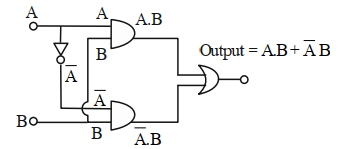
$\mathrm{Y}  =\mathrm{A} \cdot \mathrm{B}+\overline{\mathrm{A}} \cdot \mathrm{B} $

$ =(\mathrm{A}+\overline{\mathrm{A}}) \cdot \mathrm{B} $

$\mathrm{Y}  =1 \cdot \mathrm{B} $

$\mathrm{Y}  =\mathrm{B}$

Need a full question paper?

Generate a complete, print-ready paper with questions like this in minutes — across 16+ boards, with answer keys.

Start Generating Free

Similar questions

A straight wire carrying a current 10 A is bent into a semicircular arc of radius 5 cm. The magnitude of magnetic field at the center is
A $12\,V,60\,W$ lamp is connected to the secondary of a step down transformer, whose primary is connected to ac mains of $220\,V$. Assuming the transformer to be ideal, $..........\,A$ is the current in the primary winding.
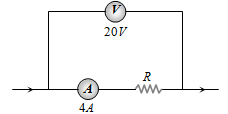
In the diagram shown, the reading of voltmeter is 20 V and that of ammeter is 4 A. The value of R should be (Consider given ammeter and voltmeter are not ideal)
Thomson coefficient of a conductor is $10\,\mu V/K$. The two ends of it are kept at ${50\,^o}C$ and ${60\,^o}C$ respectively. Amount of heat absorbed by the conductor when a charge of $10\,C$ flows through it is
A conducting sphere of radius $R = 20$ $cm$ is given a charge $Q = 16\,\mu C$. What is $\overrightarrow E $ at centre
When a telescope is adjusted for parallel light, the distance of the objective from the eye piece is found to be $80 \,cm$. The magnifying power of the telescope is $19.$ The focal lengths of the lenses are
A current of $2\,A$ flows through a wire of crosssectional area $25.0\,mm ^2$. The number of free electrons in a cubic meter are $2.0 \times 10^{28}$. The drift velocity of the electrons is $...............\times 10^{-6}\,ms ^{-1}$ (given, charge on electron $=1.6 \times 10^{-19}\,C$ )
A condenser of capacitance 10 μF has been charged to 100 volts. It is now connected to another uncharged condenser in parallel. The common potential becomes 40 volts. The capacitance of another condenser is
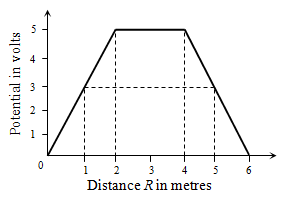
The variation of potential with distance R from a fixed point is as shown below. The electric field at R = 5 m is


A particle of mass m and charge q enters a magnetic field B perpendicularly with a velocity v, The radius of the circular path described by it will be