MCQ
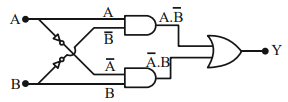
The truth table of the given circuit diagram is : 
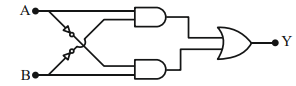
 Image 
  • A
    $\begin{array}{lll}\text { A } & \text { B } & \text { Y } \\ 0 & 0 & 1 \\ 0 & 1 & 0 \\ 1 & 0 & 0 \\ 1 & 1 & 1\end{array}$
  • B
    $\begin{array}{lll}\text { A } & \text { B } & \text { Y } \\ 0 & 0 & 0 \\ 0 & 1 & 1 \\ 1 & 0 & 1 \\ 1 & 1 & 0\end{array}$
  • C
    $\begin{array}{lll}\text { A } & \text { B } & \text { Y } \\ 0 & 0 & 0 \\ 0 & 1 & 0 \\ 1 & 0 & 0 \\ 1 & 1 & 1\end{array}$
  • D
    $\begin{array}{lll}\text { A } & \text { B } & \text { Y } \\ 0 & 0 & 1 \\ 0 & 1 & 1 \\ 1 & 0 & 1 \\ 1 & 1 & 0\end{array}$
Need a full question paper?

Generate a complete, print-ready paper with questions like this in minutes — across 16+ boards, with answer keys.

Start Generating Free

Similar questions

A uniform electric field and a uniform magnetic field are produced, pointed in the same direction. An electron is projected with its velocity pointing in the same direction
Consider the following statements :

$A.$ Atoms of each element emit characterstics spectrum.

$B.$ According to Bohr's Postulate, an electron in a hydrogen atom, revolves in a certain stationary orbit.

$C.$ The density of nuclear matter depends on the size of the nucleus.

$D.$ A free neutron is stable but a free proton decay is possible.

$E.$ Radioactivity is an indication of the instability of nuclei.

Choose the correct answer from the options given below 

Imagine an atom made up of a proton and a hypothetical particle of double the mass of the electron but having the same charge as the electron. Apply the Boh’r atocited level. The longest wavelength photon that will be emitted has wavelength $\lambda$ (given in terms of the Rydberg constant $R$ for the hydrogen atom) equal to
Three immiscible liquids of densities $d_1 > d_2 > d_3$ and refractive indices ${\mu _1} > {\mu _2} > {\mu _3}$ are put in a beaker. The height of each liquid column is $\frac{h}{3}$. A dot is made at the bottom of the beaker. For near normal vision, find apparent depth of the dot
Stress vs strain curve for the elastic tissue of the aorta, the large tube (vessel) carrying blood from the heart, will be : [stress is proportional to square of the strain for the elastic tissue of the aorta]
If pressure $P$, velocity $V$ and time $T$ are taken as fundamental physical quantities, the dimensional formula of force is
A straight wire $AB$ of mass $40\,g$ and length $50\,cm$ is suspended by a pair of flexible leads in uniform magnetic field of magnitude $0.40\,T$ as shown in the figure. The magnitude of the current required in the wire to remove the tension in the supporting leads is ...........$A$. (Take $g=10\,ms ^{-2}$ ).
The entropy of any system is given by

${S}=\alpha^{2} \beta \ln \left[\frac{\mu {kR}}{J \beta^{2}}+3\right]$

Where $\alpha$ and $\beta$ are the constants. $\mu, J, K$ and $R$ are no. of moles, mechanical equivalent of heat, Boltzmann constant and gas constant repectively. [Take ${S}=\frac{{dQ}}{{T}}$ ]

Choose the incorrect option from the following:

Three charges, each $+q,$ are placed at the comers of an isosceles triangle $ABC$ of  sides $BC$ and $AC, 2a.$ $D$ and $E$ are the mid-points of $BC$ and $CA.$ The work done in taking a charge $Q$ from $D$ to $E$ is
A block of mass $M$ on a horizontal smooth surface is pulled by a load of mass $M/2$ by means of a rope $AB$ and string $BC$ as shown in the figure. The length & mass of the rope $AB$ are $L$ and $M/2$ respectively. As the block is pulled from $AB = L$ to $AB = 0$ its acceleration changes from $3g$