Question
The two adjacent sides of a parallelogram are $2\hat{\text{i}}-4\hat{\text{j}}-5\hat{\text{k}}$ and $2\hat{\text{i}}+2\hat{\text{j}}+3\hat{\text{k}}.$ Find the two unit vectors parallel to its diagonals. Using the diagonal vectors, find the area of the parallelogram.
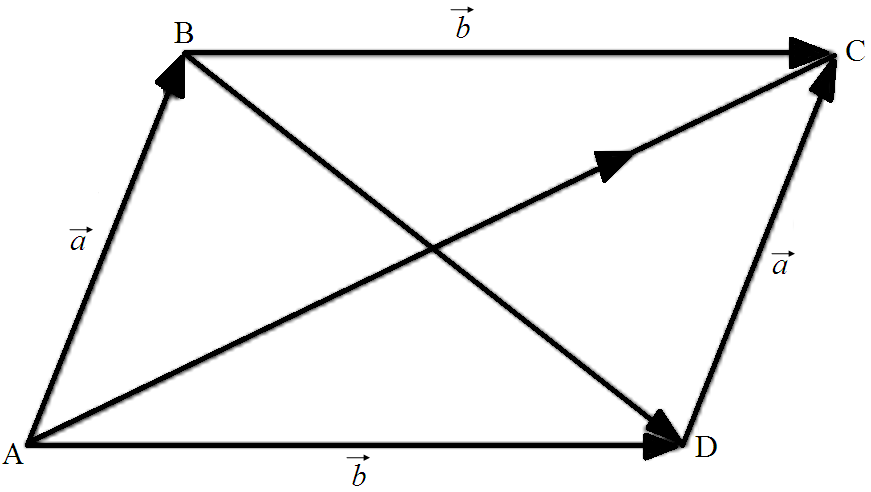
Answer

The two adjacent sides of a parallelogram are $2\hat{\text{i}}-4\hat{\text{j}}-5\hat{\text{k}}$ and $2\hat{\text{i}}+2\hat{\text{j}}+3\hat{\text{k}}.$ suppose $\vec{\text{a}}=2\hat{\text{i}}-4\hat{\text{j}}-5\hat{\text{k}}$ and $\vec{\text{b}}=2\hat{\text{i}}+2\hat{\text{j}}+3\hat{\text{k}}$

Then any one diagonal of a parallelogram is $\vec{\text{P}}=\vec{\text{a}}+\vec{\text{b}}.$
$\vec{\text{P}}=\vec{\text{a}}+\vec{\text{b}}$
$=2\hat{\text{i}}-4\hat{\text{j}}-5\hat{\text{k}}+2\hat{\text{i}}+2\hat{\text{j}}+3\hat{\text{k}}$
$=4\hat{\text{i}}-2\hat{\text{j}}-2\hat{\text{k}}$
Therefore, unit vector along the diagonal is $\frac{\vec{\text{P}}}{\big|\vec{\text{P}}\big|}=\frac{4\hat{\text{i}}-2\hat{\text{j}}-2\hat{\text{k}}}{\sqrt{16+4+4}}=\frac{2\hat{\text{i}}-\hat{\text{j}}-\hat{\text{k}}}{\sqrt{6}}.$
Another diagonal of a parallelogram is $\vec{\text{P}}'=\vec{\text{b}}-\vec{\text{a}}.$
$\vec{\text{P}}'=\vec{\text{b}}-\vec{\text{a}}$
$=2\hat{\text{i}}+2\hat{\text{j}}+3\hat{\text{k}}-2\hat{\text{i}}+4\hat{\text{j}}+5\hat{\text{k}}$
$=6\hat{\text{j}}+8\hat{\text{k}}$
Therefore, unit vector along the diagonal is $\frac{\vec{\text{P}}}{\big|\vec{\text{P}}\big|}=\frac{6\hat{\text{j}}+8\hat{\text{k}}}{\sqrt{36+64}}=\frac{6\hat{\text{j}}+8\hat{\text{k}}}{10}=\frac{3\hat{\text{j}}+4\hat{\text{k}}}{5}.$
Now,
$\vec{\text{P}}\times\vec{\text{P}}'=\begin{vmatrix}\hat{\text{i}}&\hat{\text{j}}&\hat{\text{k}}\\4&-2&-2\\0&6&8\end{vmatrix}$
$=\hat{\text{i}}(-16+12)-\hat{\text{j}}(32-0)+\hat{\text{k}}(24-0)$
$=-4\hat{\text{i}}-32\hat{\text{j}}+24\hat{\text{k}}$
Area of parallelogram $\frac{\big|\vec{\text{p}}\times\vec{\text{p}'}\big|}{2}=\frac{\sqrt{16+1024+576}}{2}=\frac{\sqrt{1616}}{2}$
$=\frac{4\sqrt{101}}{2}=2\sqrt{101}\text{ square units}$

Need a full question paper?

Generate a complete, print-ready paper with questions like this in minutes — across 16+ boards, with answer keys.

Start Generating Free

Similar questions

Maximize Z = 50x + 30y
Subject to
$2\text{x}+\text{y}\leq18$
$3\text{x}+2\text{y}\leq34$
$\text{x},\text{y}\geq0$
If $y = 2 \cos (\log x) + 3 \sin (\log x),$ Prove that $x^{2} \frac{d^{2}y}{dx}^{2} + x\frac{dy}{dx} + y = 0.$
In a hockey match, both teams A and B scored same number of goals upto the end of the game, so to decide the winner, the refree asked both the captains to throw a die alternately and decide that the team, whose captain gets a first six, will be declared the winner. If the captain of team A was asked to start, find their respective probabilities of winning the match and state whether the decision of the refree was fair or not.
Prove that $2\tan^{-1}\bigg(\sqrt{\frac{\text{a}-\text{b}}{\text{a}+\text{b}}}\tan\frac{\theta}{2}\bigg)=\cos^{-1}\Big(\frac{\text{a}\cos\theta+b}{\text{a}+\text{b}\cos\theta}\Big)$
Find the vector equation of the following planes in non-parametric form.
$\vec{\text{r}}=(\lambda-2\mu)\hat{\text{i}}+(3-\mu)\hat{\text{j}}+(2\lambda+\mu)\hat{\text{k}}$
Using matrices, solve the following system of equations:
$x + 2y + z = 7.$
$x + 3z = 11.$
$3x - 3y = 1.$
Show that the matrix $\text{A}=\begin{bmatrix} 1 & 0 & -2 \\ -2 & -1 & 2 \\ 3 & 4 & 1 \end{bmatrix}$ satisfies the equation, $A^3 - A^2 - 3A - I_3 = 0$. Hence, find $A^{-1}$.
Find the equation of the tangent to the curve $\text{y}=\sqrt{3\text{x} - 2}$ which is parallel to the line 4x - 2y + 5 = 0.
A toy company manufactures two types of dolls, A and B. Market tests and available resources have indicated that the combined production level should not exceed 1200 dolls per week and the demand for dolls type B is at most half of that for dolls of types A. Further, the production level of dolls of type A can exceed three times the production of dolls of other type by at most 600 units. If the company makes profit of Rs. 12 and Rs. 16 per doll respectively on dolls A and B, how many of each should be produced weekly in order to maximize the profit ?
Evaluate the following integrals as limit of sum:
$\int\limits^{3}_{1}\big(3\text{x}^2+1\text{x}\big)\text{dx}$