Question
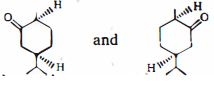
The two compounds shown below are
Answer

b
$(b)$ Given $2$ compounds are mirror images of each other and are not  superimposable on each other so are enantiomers.

Need a full question paper?

Generate a complete, print-ready paper with questions like this in minutes — across 16+ boards, with answer keys.

Start Generating Free

Similar questions

Arrange the following in increasing order of stability

$1.\,\,(CH_3)_2 - \mathop C\limits^ +   - CH_2 - CH_3$

$2.\,\,(CH_3)_3 - \mathop C\limits^ +  $

$3.\,\,(CH_3)_2 - |\mathop C\limits^ +  H|$

$4.\,\,CH_3 - \mathop C\limits^ + H_2$

$5.\,\,\mathop C\limits^ +   H_3$

The attraction that an atom exerts on a pair of electrons that are being shared between that atom and another atom to which it is bonded by a covalent bond is referred to as its
Given below are two statements :

Statement $I:$
In Lucas test, primary, secondary and tertiary alcohols are distinguished on the basis of their reactivity with conc. $HCl + ZnCl _{2}$, known as Lucas Reagent.

Statement $II :$
Primary alcohols are most reactive and immediately produce turbidity at room temperature on reaction with Lucas Reagent.

In the light of the above statements, choose the most appropriate answer from the options given below :

A gas (Molar mass $=280\,g\,mol ^{-1}$ ) was burnt in excess $O _{2}$ in a constant volume calorimeter and during combustion the temperature of calorimeter increased from $298.0 K$ to $298.45\,K$. If the heat capacity of calorimeter is $2.5\,kJ\,K ^{-1}$ and enthalpy of combustion of gas is $9\,kJ\,mol ^{-1}$ then amount of gas burnt is $......g$. (Nearest Integer)
The bond dissociation energies of gaseous ${H_2},\,C{l_2}$ and $HCl$ are $104, 58$  and $ 103\, kcal $ respectively. The enthalpy of formation of $HCl$ gas would be.....$kcal$
Which of the following will give two isomeric monochloro derivatives ?
One gram sample of $N{H_4}N{O_3}$ is decomposed in a bomb calorimeter. The temperature of the calorimeter increases by $ 6.12\, K$  the heat capacity of the system is  $1.23\, kJ/g/deg.$  What is the molar heat of decomposition for $N{H_4}N{O_3}$ ......$kJ/mol$
The compound which forms a dative bond with ammonia
$C{H_3}COO{C_2}{H_5}$ with excess of ${C_2}{H_5}MgBr$ and hydrolysis gives
Which of the following conditions is favourable for the production of ammonia by Haber's process