MCQ
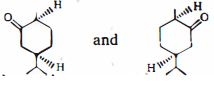
The two compounds shown below are
  • A
    diastereomers
  • enantiomers
  • C
    epimers
  • D
    regiomers

Answer

Correct option: B.
enantiomers
b
$(b)$ Given $2$ compounds are mirror images of each other and are not  superimposable on each other so are enantiomers.

Need a full question paper?

Generate a complete, print-ready paper with questions like this in minutes — across 16+ boards, with answer keys.

Start Generating Free

Similar questions

Match List $I$ with List $II$

List-$I$ (Compound) List-$II$ (Colour)
$A$ $\mathrm{Fe}_4\left[\mathrm{Fe}(\mathrm{CN})_6\right]_3 \cdot \mathrm{xH}_2 \mathrm{O}$ $I$ Violet
$B$ $\left[\mathrm{Fe}(\mathrm{CN})_5 \mathrm{NOS}\right]^{4-}$ $II$ Blood Red
$C$ $[\mathrm{Fe}(\mathrm{SCN})]^{2+}$ $III$ Prussian Blue
$D$ $\left(\mathrm{NH}_4\right)_3 \mathrm{PO}_4 \cdot 12 \mathrm{MoO}_3$ $IV$ Yellow

Choose the correct answer from the options given below :

An aqueous solution of methanol in water has vapour pressure
Which of the following will be most easily attacked by an electrophile
In methyl alcohol solution, bromine reacts with ethylene to yield $BrC{H_2}C{H_2}OC{H_3}$ in addition to $ 1, \,2-$ dibromoethane because
${H_2} + \frac{1}{2}{O_2} \to {H_2}O;\,\Delta H = - 68.39\,kcal$

$K + {H_2}O + $Water $ \to KOH(aq) + \frac{1}{2}{H_2};\,\Delta H = - 48\,kcal$

$KOH + $Water $ \to KOH(aq);\,\Delta H = - 14\,kcal$

The heat of formation of $KOH$ is (in kcal)

Which of the following isomeric heptanes can yield seven different monochlorinated products upon free radical chlorination ? (structured only)
How many $S-S$ bond, $S-O-S$ bond, $\sigma$ bonds and $\pi$ bonds are present in trimer of $SO_3.$
Highest ionisation energy stands for
Given that the standard potentials $\left(\mathrm{E}^{\circ}\right)$ of $\mathrm{Cu}^{2+}{/ \mathrm{Cu}}$ and $\mathrm{Cu}^{+}{/ \mathrm{Cu}}$ are $0.34 \;\mathrm{V}$ and $0.522 \;\mathrm{V}$ respectively, the ${E}^{\circ}$ of ${C u}^{2+}{/ {C u}^{+}}$ is
$2p$  orbitals have