MCQ
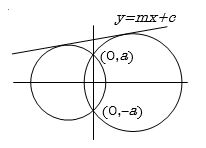
The two circles which passes through $(0,a)$ and $(0, - a)$ and touch the line $y = mx + c$ will intersect each other at right angle, if
  • A
    ${a^2} = {c^2}(2m + 1)$
  • B
    ${a^2} = {c^2}(2 + {m^2})$
  • ${c^2} = {a^2}(2 + {m^2})$
  • D
    ${c^2} = {a^2}(2m + 1)$

Answer

Correct option: C.
${c^2} = {a^2}(2 + {m^2})$
c
(c) Equation of circles

$[{x^2} + (y - a)(y + a)] + \lambda x = 0 \Rightarrow {x^2} + {y^2} + \lambda x - {a^2} = 0$

and $\sqrt {{{\left( {\frac{\lambda }{2}} \right)}^2} + {a^2}} = \frac{{\frac{{ - m\lambda }}{2} + c}}{{\sqrt {1 + {m^2}} }}$

$ \Rightarrow (1 + {m^2}){\rm{ }}\left[ {\frac{{{\lambda ^2}}}{4} + {a^2}} \right] $

$= {\left( {\frac{{m\lambda }}{2} - c} \right)^2}$

$ \Rightarrow (1 + {m^2}){\rm{ }}\left[ {\frac{{{\lambda ^2}}}{4} + {a^2}} \right] $

$= \frac{{{m^2}{\lambda ^2}}}{4} - mc\lambda + {c^2}$

$ \Rightarrow {\lambda ^2} + 4mc\lambda + 4{a^2}(1 + {m^2}) - 4{c^2} = 0$

$\therefore $${\lambda _1}{\lambda _2} = 4[{a^2}(1 + {m^2}) - {c^2}]$

$\Rightarrow {g_1}{g_2} = [{a^2}(1 + {m^2}) - {c^2}]$

and ${g_1}{g_2} + {f_1}{f_2} = \frac{{{c_1} + {c_2}}}{2}$

$\Rightarrow {a^2}(1 + {m^2}) - {c^2} = - {a^2}$

Hence ${c^2} = {a^2}(2 + {m^2})$.
Need a full question paper?

Generate a complete, print-ready paper with questions like this in minutes — across 16+ boards, with answer keys.

Start Generating Free

Similar questions

If $\vec a = 2\hat i - \hat j + \hat k,\,\,\vec b = \hat i + \hat j - 2\hat k$ and $\vec c = \hat i + 3\hat j - \left( {{\lambda ^2} + 3\lambda } \right)\hat k$ (where $\lambda $ is a constant) and  $\vec a $ is perpendicular to $\vec c - \lambda \vec b$, then sum of different values of  $\lambda$ is
The angle of intersection between the curves ${x^2} = 8y$ and ${y^2} = 8x$ at origin is
Let $[\mathrm{x}]$ denote the greatest integer less than or equal to $\mathrm{x}$. Then, the values of $x \in R$ satisfying the equation $\left[e^{x}\right]^{2}+\left[e^{x}+1\right]-3=0$ lie in the interval:
Let $f(x) = \left\{ {\begin{array}{*{20}{c}}
{\frac{{{{(1 + \tan x)}^{\frac{1}{x}}} - e}}{x};x \ne 0}\\
{k\,\,\,\,\,\,\,\,\,\,\,\,\,\,\,\,\,\,\,\,\,\,\,\,\,\,\,\,\,;x \ne 0}
\end{array}} \right.$ be continuous at $x = 0$, then $k$ is-
If $f(x) = \sin \log x$, then the value of $f(xy) + f\left( {\frac{x}{y}} \right) - 2f(x).\cos \log y$ is equal to
$\int_{}^{} {\sqrt {2 + \sin 3x} \;.\;\cos 3x\;dx = } $
A solution curve of the differential equation $\left(x^2+x y+4 x+2 y+4\right) \frac{c^{\prime} y}{c^{\prime} x}-y^2=0, x>0$, passes through the point $(1,3)$. Then the solution curve

($A$) intersects $y=x+2$ exactly at one point

($B$) intersects $y=x+2$ exactly at two points

($C$) intersects $y=(x+2)^2$

($D$) does $NOT$ intersect $y=(x+3)^2$

If lines $\frac{{x - 3}}{2} = \frac{{y + 1}}{{ - 3}} = \frac{{z + a}}{p}$ and $\frac{{x + 2}}{2} = \frac{{y - 4}}{4} = \frac{{z + 5}}{2}$ are perpendicular coplanar lines, then value of $a + p$ is
Let $O$ be the origin and $OP$ and $OQ$ be the tangents to the circle $x^2+y^2-6 x+4 y+8=0$ at the point $P$ and $Q$ on it. If the circumcircle of the triangle OPQ passes through the point $\left(\alpha, \frac{1}{2}\right)$, then a value of $\alpha$ is
The sum of all natural numbers between $1$ and $100$ which are multiples of $3$ is