Question
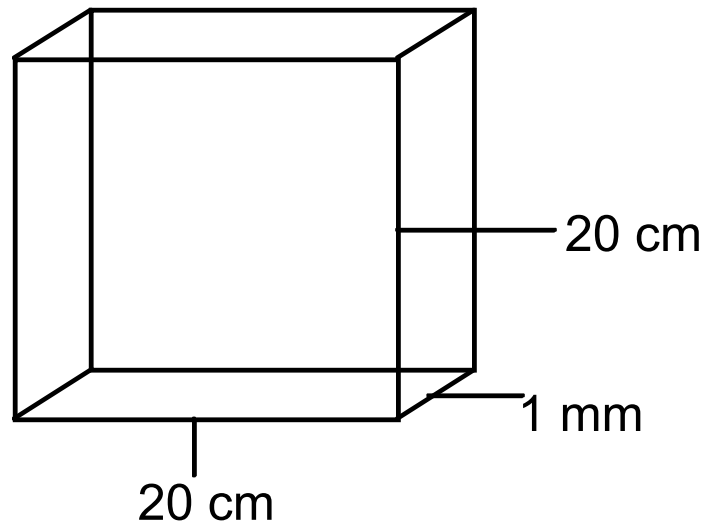
The two square faces of a rectangular dielectric slab $($dielectric constant $4.0)$ of dimensions $20\ cm \times 20\ cm \times 1.0mm$ are metal$-$coated. Find the capacitance between the coated surfaces.
Answer


$A = 20\ cm \times 20\ cm = 4 \times 10^{-2}m$
$d = 1m = 1 \times 10^{-3}m$
$k = 4$
$t = d$
$\text{C}=\frac{\epsilon_0\text{A}}{\text{d}-\text{t}+\frac{\text{t}}{\text{k}}}=\frac{\epsilon_0\text{A}}{\text{d}-\text{d}+\frac{\text{d}}{\text{k}}}=\frac{\epsilon_0\text{Ak}}{\text{d}}$
$=\frac{8.85\times10^{-12}\times4\times10^{-2}\times4}{1\times10^{-3}}$
$=141.6\times10^{-9}\text{F}=1.42\text{nf}$

Need a full question paper?

Generate a complete, print-ready paper with questions like this in minutes — across 16+ boards, with answer keys.
Start Generating Free

Similar questions

  1. Find the radius of the circular orbit of a satellite moving with an angular speed equal to the angular speed of earth's rotation.
  2. If the satellite is directly above the north pole at some instant, find the time it takes to come over the equatorial plane. Mass of the earth $= 6 \times 10^{24}kg.$
A square loop of side $12\ cm$ with its sides parallel to $X$ and $Y$ axes is moved with a velocity of $8\ cms^{–1}$ in the positive $x-$ direction in an environment containing a magnetic field in the positive $z-$ direction. The field is neither uniform in space nor constant in time. It has a gradient of $10^{–3}T \ cm^{–1}$ along the negative $x-$ direction $($that is it increases by $10^{–3}T \ cm^{–1}$ as one moves in the negative $x-$ direction$),$ and it is decreasing in time at the rate of $10 ^{–3}T s^{–1}$. Determine the direction and magnitude of the induced current in the loop if its resistance is $4.50 m\Omega$ .
Find the typical de Broglie wavelength associated with a $He$ atom in helium gas at room temperature $(27^\circ C)$ and $1$ atm pressure; and compare it with the mean separation between two atoms under these conditions.
An object 1.5 cm in size is placed on the side of the convex lens in the arrangement (a) above. The distance between the object and the convex lens is 40 cm. Determine the magnification produced by the two-lens system, and the size of the image.
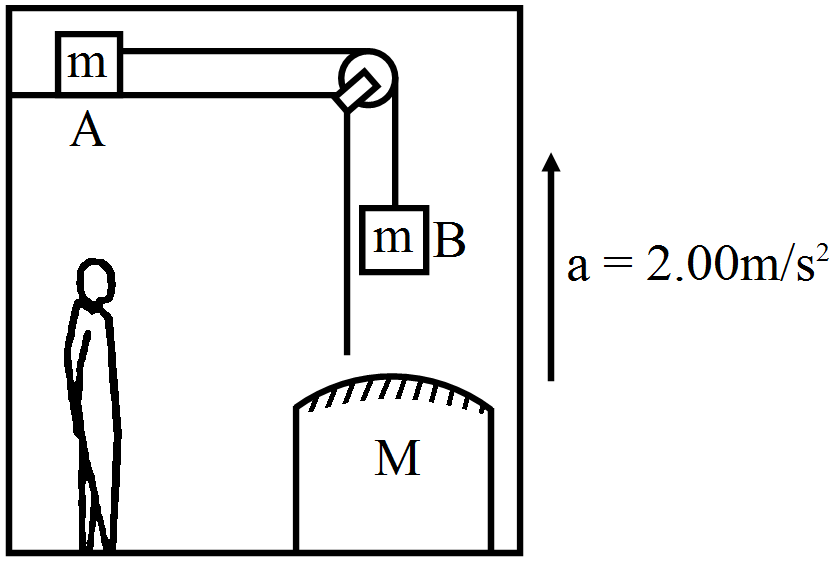
Consider the situation shown in figure. The elevator is going up with an acceleration of $2.00m/s^2$ and the focal length of the mirror is $12.0\ cm$. All the surfaces are smooth and the pulley is light. The mass $-$ pulley system is released from rest $($with respect to the elevator$)$ at $t = 0$ when the distance of $B$ from the mirror is $42.0\ cm$. Find the distance between the image of the block $B$ and the mirror at $t = 0.200s$. Take $g = 10m/s^2.$
Coulomb's law for electrostatic force between two point charges and Newton's law for gravitational force between two stationary point masses, both have inverse-square dependence on the distance between the charges and masses respectively. (a) Compare the strength of these forces by determining the ratio of their magnitudes (i) for an electron and a proton and (ii) for two protons. (b) Estimate the accelerations of electron and proton due to the electrical force of their mutual attraction when they are $1 \mathring A\left(=10^{-10} m \right)$ apart? $\left(m_p=1.67 \times\right.$ $\left.10^{-27} kg , m_e=9.11 \times 10^{-31} kg \right)$
A particle is observed from two frames $S_1$ and. $S_2.$ The frame $S_{2 }$ moves with respect to $S_{1 }$ with an acceleration $a$. Let $F_1$ and $F_2$ be the pseudo forces on the particle when seen from $S_1$ and $S_2$ respectively. Which of the following are not possible?
A capacitance C, a resistance R and an emf $\epsilon$ are connected in series at t = 0. What is the maximum value of (a) the potential difference across the resistor (b) the current in the circuit (c) the potential difference across the capacitor (d) the energy stored in the capacitor (e) the power delivered by the battery and (f) the power converted into heat?
A motorcycle has to move with a constant speed on an overbridge which is in the form of a circular arc of radius R and has a total length L. Suppose the motorcycle starts from the highest point.
  1. What can its maximum velocity be for which the contact with the road is not broken at the highest point?
  2. If the motorcycle goes at speed $\frac{1}{\sqrt2}$ times the maximum found in part (a), where will it lose the contact with the road?
  3. What maximum uniform speed can it maintain on the bridge if it does not lose contact anywhere on the bridge?
Two parallel wires seprated by a distance of 10cm carry currents of 10A and 40A along-the same direction. Where should a third current be placed so that it experiences no magnetic force?