MCQ
The unit of absolute permittivity is
  • A
    $Fm$ (Farad-meter)
  • $F{m^{ - 1}}$ (Farad/meter)
  • C
    $F{m^{ - 2}}$(Farad/$metr{e^2}$)
  • D
    $F$ (Farad)

Answer

Correct option: B.
$F{m^{ - 1}}$ (Farad/meter)
b
(b)

Need a full question paper?

Generate a complete, print-ready paper with questions like this in minutes — across 16+ boards, with answer keys.

Start Generating Free

Similar questions

Light is incident normally on a completely absorbing surface with an energy flux of $25\,W\,cm^{-2}.$ If the surface has an area of $25\,cm^2,$ the maximum momentum transferred to the surface in $40\,min$ time duration will be
Arrange the following in the ascending order of wavelength :

$(A)$ Gamma rays $\left(\lambda_1\right)$

$(B)$ x-ray $\left(\lambda_2\right)$

$(C)$ Infrared waves $\left(\lambda_3\right)$

$(D)$ Microwaves $\left(\lambda_4\right)$

Choose the most appropriate answer from the options given below :
A satellite of mass $m,$ initially at rest on the earth, is launched into a circular orbit at a height equal to the radius of the earth. The minimum energy required is
A compass needle will show which one of the following directions at the earth's magnetic pole
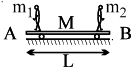
Two persons of mass $m_1$ and $m_2$ are standing at the two ends $A$ and $B $ respectively, of $a$ trolley of mass $M$ as shown. When both the persons jump simultaneously with urel with respect to the trolley, then the velocity of the trolley is
If the earth is at one-fourth of its present distance from the sun, the duration of the year will be
Two particles of masses $M$ and $4M$ are released from a distance $10\,metres$ from each other. Find the point of collision from smaller particle .............. $\mathrm{metres}$
The energy density $u$ is plotted against the distance $r$ from the centre of a spherical charge distribution on a $log$-$log$ scale. The slope of obtianed straight line is :
In a $LCR$ oscillatory circuit find the energy stored in inductor at resonance. If voltage of source is $10 \,V$ and resistance is $10\, \Omega$ and inductance $=1 H$. (in $J$)
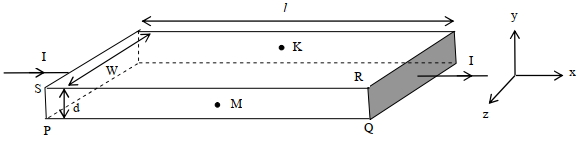
In a thin rectangular metallic strip a constant current $I$ flows along the positive $x$-direction, as shown in the figure. The length, width and thickness of the strip are $\ell$, w and $d$, respectively. A uniform magnetic field $\vec{B}$ is applied on the strip along the positive $y$-direction. Due to this, the charge carriers experience a net deflection along the $z$ direction. This results in accumulation of charge carriers on the surface $P Q R S$ and appearance of equal and opposite charges on the face opposite to $PQRS$. A potential difference along the $z$-direction is thus developed. Charge accumulation continues until the magnetic force is balanced by the electric force. The current is assumed to be uniformly distributed on the cross section of the strip and carried by electrons.

$1.$ Consider two different metallic strips ($1$ and $2$) of the same material. Their lengths are the same, widths are $w_1$ and $w_2$ and thicknesses are $d_1$ and $d_2$, respectively. Two points $K$ and $M$ are symmetrically located on the opposite faces parallel to the $x$ - $y$ plane (see figure). $V _1$ and $V _2$ are the potential differences between $K$ and $M$ in strips $1$ and $2$ , respectively. Then, for a given current $I$ flowing through them in a given magnetic field strength $B$, the correct statement$(s)$ is(are)

$(A)$ If $w _1= w _2$ and $d _1=2 d _2$, then $V _2=2 V _1$

$(B)$ If $w_1=w_2$ and $d_1=2 d_2$, then $V_2=V_1$

$(C)$ If $w _1=2 w _2$ and $d _1= d _2$, then $V _2=2 V _1$

$(D)$ If $w _1=2 w _2$ and $d _1= d _2$, then $V _2= V _1$

$2.$ Consider two different metallic strips ($1$ and $2$) of same dimensions (lengths $\ell$, width w and thickness $d$ ) with carrier densities $n_1$ and $n_2$, respectively. Strip $1$ is placed in magnetic field $B_1$ and strip $2$ is placed in magnetic field $B_2$, both along positive $y$-directions. Then $V_1$ and $V_2$ are the potential differences developed between $K$ and $M$ in strips $1$ and $2$, respectively. Assuming that the current $I$ is the same for both the strips, the correct option$(s)$ is(are)

$(A)$ If $B_1=B_2$ and $n_1=2 n_2$, then $V_2=2 V_1$

$(B)$ If $B_1=B_2$ and $n_1=2 n_2$, then $V_2=V_1$

$(C)$ If $B _1=2 B _2$ and $n _1= n _2$, then $V _2=0.5 V _1$

$(D)$ If $B_1=2 B_2$ and $n_1=n_2$, then $V_2=V_1$

Give the answer question $1$ and $2.$