MCQ
The unit of electric permittivity is
  • A
    $Volt/m^2$
  • B
    $Joule/coulomb$
  • $Farad/m$
  • D
    $Henry/m$

Answer

Correct option: C.
$Farad/m$
c
(c) $C = \frac{{{\varepsilon _0}A}}{d}$ $⇒$ ${\varepsilon _0} = \frac{{Cd}}{A}$ $⇒$ ${\varepsilon _0}$ $⇒$ $\frac{{Farad \times m}}{{{m^2}}} \to \frac{F}{m}$

Need a full question paper?

Generate a complete, print-ready paper with questions like this in minutes — across 16+ boards, with answer keys.
Start Generating Free

Similar questions

If black wire of platinum is heated, then its colour first appear red, then yellow and finally white. It can be understood on the basis of
If the temperature of the sun were to be increased from $T$ to $2T$ and its radius from $R$ to $2R$ , then the ratio of the radiant energy received on the earth to what it was previously will be
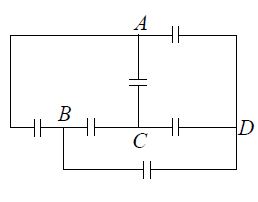
Choose the correct statement for the given capacitor arrangement. (All the $6$ capacitor are of same capacitance)
When two sound waves travel in the same direction in a medium, the displacements of a particle located at $'x'$ at time $'t'$ is given by

${y_1} = 0.05\,\cos \,\left( {0.50\,\pi x - 100\,\pi t} \right)$

${y_2} = 0.05\,\cos \,\left( {0.46\,\pi x - 92\,\pi t} \right)$

then velocity is..... $m/s$
Wavelength of light of frequency $100\;Hz$
A parallel combination of two resistors, of $1  \,\Omega$ each, is connected in series with a $1.5  \,\Omega$ resistor. The total combination is connected across a $10\, V$ battery. The current flowing in the circuit is .............. $A$
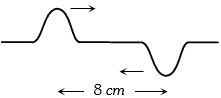
Two pulses in a stretched string whose centres are initially $8 cm$ apart are moving towards each other as shown in the figure. The speed of each pulse is $2 cm/s$. After $2$ seconds, the total energy of the pulses will be
A big drop is formed by coalescing $1000$ small identical drops of water. If $E_1$ be the total surface energy of $1000$ small drops of water and $E_2$ be the surface energy of single big drop of water, the $E_1$ : $\mathrm{E}_2$ is $\mathrm{x}: 1$ where $x$ =_____.
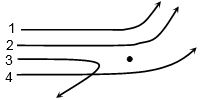
The diagram shows the path of four $\alpha  - $ particles of the same energy being scattered by the nucleus of an atom simultaneously. Which of these are/is not physically possible
A sand dropper drops sand of mass $m ( t )$ on a conveyer belt at a rate proportional to the square root of speed (v) of the belt, i.e. $\frac{d m}{d t} \propto \sqrt{ v }$. If P is the power delivered to run the belt at constant speed then which of the following relationship is true?