MCQ
The unit of "impulse per unit area" is same as that of
  • Viscosity
  • B
    Surface tension
  • C
    Bulk modulus
  • D
    Force

Answer

Correct option: A.
Viscosity
a
(a)

$\frac{\text { Impulse }}{\text { Area }}=\frac{M L T^{-1}}{L^2} \Rightarrow\left[ ML ^{-1} T ^{-1}\right]$

Coefficient of viscosity $\Rightarrow \eta=\left[ ML ^{-1} T^{-1}\right]$

So, $\frac{\text { Impulse }}{\text { Area }}=$ coefficient of viscosity

Need a full question paper?

Generate a complete, print-ready paper with questions like this in minutes — across 16+ boards, with answer keys.

Start Generating Free

Similar questions

Given below are two statements:

Statements $I:$ The temperature of a gas is $-73^{\circ}\,C$. When the gas is heated to $527^{\circ}\,C$, the root mean square speed of the molecules is doubled.

Statement $II:$ The product of pressure and volume of an ideal gas will be equal to translational kinetic energy of the molecules.

In the light of the above statements, choose the correct answer from the options given below :
Match List $I$ with List $II$

LIST$-I$ LIST$-II$
$(A)$ Surface tension $(I)$ $Kg m ^{-1} s ^{-1}$
$(B)$ Pressure $(II)$ $Kg ms^{-1 }$
$(C)$ Viscosity $(III)$ $Kg m ^{-1} s ^{-2}$
$(D)$ Impulse $(IV)$ $Kg s ^{-2}$

Choose the correct answer from the options given below :

A disc of radius $5\, m$ is rotating with angular frequency $10\, rad / sec .$ A block of mass $2\, kg$ to be put on the disc friction coefficient between disc and block is $\mu_{ k }=0.4,$ then find the maximum distance from axis where the block can be placed without sliding (in $cm$)
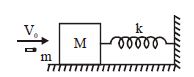
A bullet of mass $m$ strikes a block of mass $M$ connected to a light spring of stiffness $k$ , with a speed $V_0$ . If the bullet gets embedded in the block then, the maximum compression in the spring is
The coordinates of a moving particle at any time are given by $x = a{t^2}$ and $y = b{t^2}$. The speed of the particle at any moment is
A ball of mass $m$ is thrown vertically upward. Another ball of mass $2\,m$ is thrown an angle $\theta$ with the vertical. Both the balls stay in air for the same period of time. The ratio of the heights attained by the two balls respectively is $\frac{1}{x}$. The value of $x$ is $.....$
The potential energy of a particle $\left(U_x\right)$ executing $S.H.M$. is given by
A ball is dropped from a height $h$. If the coefficient of restitution be $e$, then to what height will it rise after jumping twice from the ground
The temperature of a hypothetical gas increases to $\sqrt 2 $ times when compressed adiabatically to half the volume. Its equation can be written as
Two vector $A$ and $B$ have equal magnitudes. Then the vector $\mathop A\limits^ \to + \mathop B\limits^ \to $ is perpendicular to