MCQ
The unit of molality is
  • A
    Mole per litre
  • Mole per kilogram
  • C
    Per mole per litre
  • D
    Mole litre

Answer

Correct option: B.
Mole per kilogram
b
(b)The unit of molality is mole per kilogram.

Need a full question paper?

Generate a complete, print-ready paper with questions like this in minutes — across 16+ boards, with answer keys.

Start Generating Free

Similar questions

The amount of energy required to break a bond is same as the amount of energy released when the same bond is formed. In gaseous state, the energy required for homolytic cleavage of a bond is called Bond Dissociation Energy $(BDE)$ or Bond Strength.
$\text{BDE}$ is affected by $s-$character of the bond and the stability of the radicals formed.
Shorter bonds are typically stronger bonds. $\text{BDEs}$ for some bonds are given below
:$\begin{array}{l} Cl - Cl ( g ) \longrightarrow Cl ^*( g )+ Cl ^*( g ) \Delta H ^{\circ}=58 \ kcal \ mol ^{-1} \end{array}$
$ H _3 C - Cl ( g ) \longrightarrow H _3 C ^*( g )+ Cl ^{\circ}( g ) \Delta H ^{\circ}=85 \ kcal \ mol ^{-1} $
$ H - Cl ( g ) \quad \longrightarrow H ^*( g ) \quad+ Cl ^*( g ) \Delta H ^{\circ}=103 \ kcal \ mol ^{-1} $
$(1)$ Correct match of the $C - H$ bonds (shown in bold) in Column $J$ with their $\text{BDE}$ in Column $K$ is
Column $J$ Molecule Column $K$ $\operatorname{BDE}( kcal mol -1)$
$(P)$ $H - C H \left( CH _3\right)_2$ ${ (i) } 132$
$(Q)$ $H - CH _2 Ph$ ${ (ii) } 110$
$(R)$ $H - C H = CH _2$ ${ (iii) } 95$
$(S)$ $H - C \equiv CH$ ${ (iv) } 88$
$(A) P - iii, Q - iv, R - ii, S - i$
$(B) P - i, Q - ii, R - iii, S - iv$
$(C) P - iii, Q - ii, R - i, S - iv$
$(D) P - ii, Q - i, R - iv, S - iii$
$(2)$ For the following reaction
$CH _4( g )+ Cl _2( g ) \xrightarrow{\text { light }} CH _3 Cl ( g )+ HCl ( g )$
the correct statement is
$(A)$ Initiation step is exothermic with $\Delta H ^{\circ}=-58 \ kcal \ mol ^{-1}$
$(B)$ Propagation step involving ${ }^{\circ} CH _3$ formation is exothermic with $\Delta H ^{\circ}=-2 \ kcal \ mol ^{-1}$.
$(C)$ Propagation step involving $CH _3 Cl$ formation is endothermic with $\Delta H ^{\circ}=+27 \ kcal \ mol ^{-1}$.
$(D)$ The reaction is exothermic with $\Delta H ^{\circ}=-25 \ kcal \ mol ^{-1}$.
Examine the following resonating structures of formic acid for their individual  stability and then answer the question given below.

Which of the following arrangements gives the correct order of decreasing stability of the above-mentioned resonance contributors?

$\begin{array}{*{20}{c}}
  {\,\,\,C{H_3}\,\,\,\,\,\,} \\ 
  {|\,\,\,\,\,\,\,\,\,\,\,\,} \\ 
  {C{H_3} - C - O - C{H_3}} \\ 
  {|\,\,\,\,\,\,\,\,\,\,\,\,} \\ 
  {\,\,\,\,C{H_3}\,\,\,\,\,\,} 
\end{array}$ $\xrightarrow{{Conc.HI}}$ 

Type of reaction in above reaction is

In a set of the given reactions, acetic acid yielded a product C.Product C would be

$C{H_3}COOH + PC{l_5} \to A\mathop {\xrightarrow{{{C_6}{H_6}}}}\limits_{anh.\,AlC{l_3}} $ $B\mathop {\xrightarrow{{{C_2}{H_5}MgBr}}}\limits_{ether} C$

A reaction occurs spontaneously if
Which one of the following species possesses maximum size
At $298\,K$, a 1 litre solution containing $10\,m\,mol$ of $Cr _2 O _7{ }^{2-}$ and $100\,m\,mol$ of $Cr ^{3+}$ shows a $pH$ of $3.0$.

Given : $Cr _2 O _7^{2-} \rightarrow Cr ^{3+} ; E ^0=1.330\,V$ and

$\frac{2.303 RT }{ F }=0.059\,V$

The potential for the half cell reaction is $x \times 10^{-3}\,V$. The value of $x$ is $........$
Which of the following complex ions has electrons that are symmetrically filled in both $t_{2g}$, and $e_g$ orbitals ?
Assign $A, B, C, D$ from given type of reaction. $Fe\left( s \right) + 2HCl \longrightarrow FeC{l_2} + {H_2}$
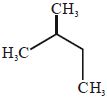
(image) $\xrightarrow{C{{l}_{2}},hv}$ $N$ (isomeric products), $C_5H_{11}Cl$  $\xrightarrow[\text{distillation}]{\text{Fractional}}$ $M$ (isomeric products) Given the number of $N$ and $M$