MCQ
The units of modulus of rigidity are
  • A
    $N - m$
  • B
    $N/m$
  • C
    $N - {m^2}$
  • $N/{m^2}$

Answer

Correct option: D.
$N/{m^2}$
d
We know that the modulus of rigidity is defined as:

$Y =\frac{\text { Stress }}{\text { Strain }}$

Since strain is a dimensionless quantity. So its unit will be same as that of stress.

Need a full question paper?

Generate a complete, print-ready paper with questions like this in minutes — across 16+ boards, with answer keys.
Start Generating Free

Similar questions

A heat engine operates between a cold reservoir at temperature ${T}_{2}=400\, {K}$ and a hot reservoir at temperature ${T}_{1} .$ It takes $300 \,{J}$ of heat from the hot reservoir and delivers $240\, {J}$ of heat to the cold reservoir in a cycle. The minimum temperature of the hot reservoir has to be $....{K}$
Consider two observers moving with respect to each other at a speed v along a straight line. They observe a bock of mass m moving a distancel on a rough surface. The following quantities will be same as observed by the two observers.
Two masses $m_1$ and $m_2$ connected by a spring of spring constant $k$ rest on a frictionless surface. If the masses are pulled apart and let go, the time period of oscillation is
The angle of projection at which the horizontal range and maximum height of projectile are equal is
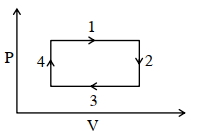
An ideal gas undergoes a four step cycle as shown in the $P-V$ diagram below. During this cycle, in which step heat is absorbed by the gas
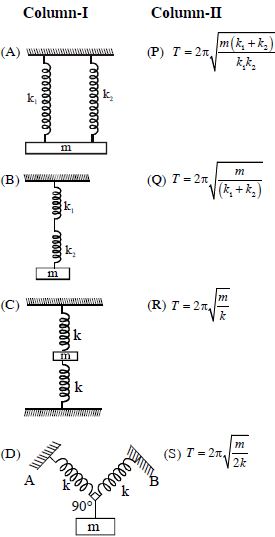
In the following questions, match column $-I$ with column $-II$ and choose the correct options
Two interfering waves have the same wavelength, frequency, and amplitude. They are traveling in the same direction but are $90^o$ out of phase. Compared to the individual waves, the resultant wave will have the same.
A black hole is an object whose gravitational field is so strong that even light cannot escape from it. To what approximate radius would earth $($ mass $= 5 .98 \times \,10^{24}\, kg)$ have to be compressed to be a black hole?
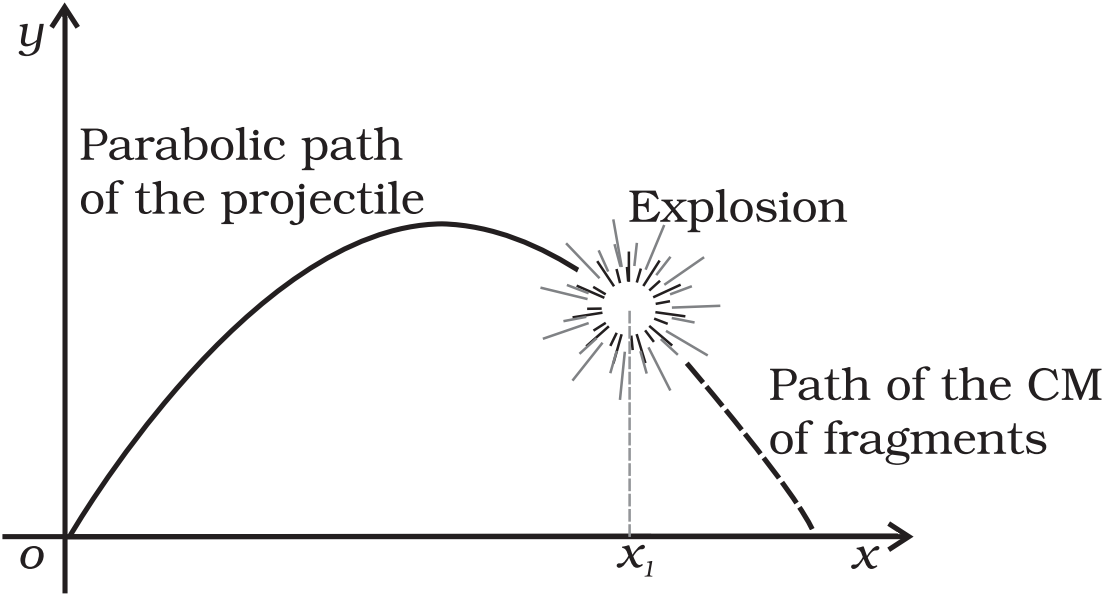
A projectile is fired at an angle and it was following a parabolic path. Suddenly, it explodes into fragments. Choose the correct option regarding this situation.

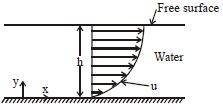
For the situation shown in the figure, water flows on the surface of a fixed plate. The
velocity of water as a function of distance $'y'$ is given as : $u = \alpha \left[ {\frac{y}{h} - 2{{\left( {\frac{y}{h}} \right)}^2}} \right]$ . Determine the magnitude of the shear stress that the water applies at the base of the plate. Coefficient of viscosity is $\eta$