MCQ
The upper limit temperature of a super conductor is:
  • A
    $115K$
  • B
    $120K$
  • $125K$
  • D
    $130K$

Answer

Correct option: C.
$125K$

Superconductors are materials that conduct electricity with no resistance. This means that, unlike the more familiar conductors such as copper or steel, a superconductor can carry a current indefinitely without losing any energy.
The upper limit temperature of a superconductor is $125K$

Need a full question paper?

Generate a complete, print-ready paper with questions like this in minutes — across 16+ boards, with answer keys.
Start Generating Free

Similar questions

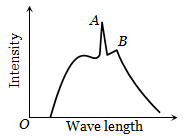
The figure represents the observed intensity of X-rays emitted by an X-ray tube as a function of wavelength. The sharp peaks A and B denote
If the magnetic field of a plane electromagnetic wave is given by (The speed of light $ = 3 \times {10^8}\,m/s$ )

$B = 100 \times {10^{ - 6}}\,\sin \,\left[ {2\pi  \times 2 \times {{10}^{15}}\,\left( {t - \frac{x}{c}} \right)} \right]$ 

then the maximum electric field associated with it is

The wavelength $\lambda $ of the ${K_\alpha }$ line of characteristic $X-$ ray spectra varies with atomic number approximately
If the refractive index of denser medium 1 relative to rare medium 2 is $n_{12}$ and the critical angle for the pair of these mediums is $i_{ c }$, then the relationship between $n _{12}$ and $i_c$ is :
The time period of oscillation of a bar magnet suspended horizontally along the magnetic meridian is $T_0$. If this magnet is replaced by another magnet of the same size and pole strength but with double the mass, the new time period will be
What is the amount of energy released by deuterium and tritium fusion?
Magnetic induction is a
If $\lambda_1$ and $\lambda_2$ denote the wavelengths of de Broglie waves for  electrons in the first and second Bohr orbits in a hydrogen atom, then $\lambda_1/\lambda_2$ is equal to 
Choose the correct statement(s) for hydrogen and deuterium atoms (considering motion of nucleus)
Consider a ray of light incident from air onto a slab of glass (refractive index $n$ ) of width d , at an angle $\theta$. The phase difference between the ray reflected by the top surface of the glass and the bottom surface is