MCQ
The value of contact angle for kerosene with solid surface ........ $^o$
  • $0$
  • B
    $90$
  • C
    $45$
  • D
    $33$

Answer

Correct option: A.
$0$
a
The value of contact angle for kerosene with solid surface is $0^{\circ}$

Need a full question paper?

Generate a complete, print-ready paper with questions like this in minutes — across 16+ boards, with answer keys.
Start Generating Free

Similar questions

Mark the correct statement :-
During an adiabatic process, the pressure of a gas is found to be proportional to the cube of its temperature. The ratio of  $\frac{{{C_P}}}{{{C_V}}}$  for the gas is
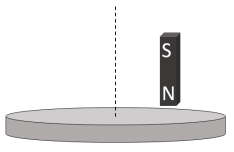
A light disc made of aluminium (a nonmagnetic material) is kept horizontally and is free to rotate about its axis as shown in the figure. A strong magnet is held vertically at a point above the disc away from its axis. On revolving the magnet about the axis of the disc, the disc will (figure is schematic and not drawn to scale)-
In the following reaction $_{12}M{g^{24}}{ + _2}H{e^4}{ \to _{14}}S{i^X}{ + _0}{n^1},X$ is
If the excess pressure inside a soap bubble is balanced by oil column of height $2\; mm$, then the surface tension of soap solution will be ($r = 1 \,cm$ and density $d = 0.8\, gm/cc$)
The force between the plates of a parallel plate capacitor of capacitance $C$ and distance of separation of the plates $d$ with a potential difference $V$ between the plates, is
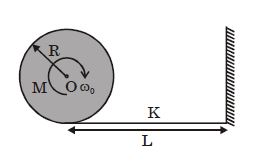
A uniform solid cylinder of mass $M$ and radius $R$ can freely rotate around its axis $O$ . There is a elastic string of relaxed length $L$ and stiffness $K$ attached to the cylinder and a static wall. Initially, the string is relaxed. As the cylinder starts rotating, the string will wind the cylinder. The surface of cylinder is very rough, so that the string does not slip on the cylinder’s surface. The minimum initial angular speed of the cylinder, ${\omega _0}$ , so that it can rotate to angle $2\pi $ is (Assume Hooke’s law to be valid.)
In $YDSE$ setup, light of wavelength $640\,nm$ is used with $d = 0.8\,mm$ and $D = 1\,m.$ If intensity at central maximum is $I_0$ and its position is $y = 0,$ then
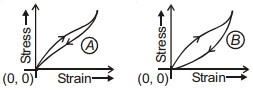
Two different types of rubber are found to have the stress-strain curves as shown. Then
$A$ block of mass $m$ moving with a velocity $v_0$ on a smooth horizontal surface strikes and compresses a spring of stiffness $k$ till mass comes to rest as shown in the figure. This phenomenon is observed by two observers:

$A$: standing on the horizontal surface

$B$: standing on the block To an observer

$A$, the work done by the normal reaction $N$ between the block and the spring on the block is