MCQ
The value of $\int\limits_0^2 {\frac{{dx}}{{{{(1 - x)}^2}}}} $ is
  • A
    $-2$
  • B
    $0$
  • C
    $15$
  • indeterminate

Answer

Correct option: D.
indeterminate
d
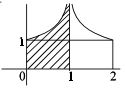
$\int\limits_0^2 {\frac{{dx}}{{{{(1 - x)}^2}}}} $ $= \int\limits_0^{{1^ - }} {\frac{{dx}}{{{{(1 - x)}^2}}}} \,\, + \,\,\int\limits_{{1^ + }}^2 {\frac{{dx}}{{{{(1 - x)}^2}}}} \,$

$= \left. {\frac{1}{{1 - x}}} \right]_0^{{1^ - }}\,\, + \,\,\left. {\frac{1}{{1 - x}}} \right]_{{1^ + }}^2$

$= (\infty - 1) + (-1) - (- \infty ) \Rightarrow$ indeterminant

Note that the shaded area is divergent 
Need a full question paper?

Generate a complete, print-ready paper with questions like this in minutes — across 16+ boards, with answer keys.

Start Generating Free

Similar questions

The minimum value of function $f(x) = 3{x^4} - 8{x^3} + 12{x^2} - 48x + 25$ on $[0, 3] $ is equal to
The solution of the differential equation $(1 + {x^2})(1 + y)dy + (1 + x)(1 + {y^2})dx = 0$ is
Let $f(x) = \left\{ {\begin{array}{*{20}{c}} {a\sin \left( {x + b} \right)}&{x \ge 0}\\ {6{x^7} - x + 1}&{x < 0} \end{array}} \right.$ is differentiable for all real $x$. If $a \in R$ and $b \in \left[ {0,2\pi } \right]$ , then number of ordered pair $(s)$ of $(a, b)$ is
The probability of men getting a certain disease is $\frac{1}{2}$ and that of women getting the same disease is $\frac{1}{5}$. The blood test that identifies the disease gives the correct result with probability $\frac{4}{5}$. Suppose a person is chosen at random from a group of $30$ males and $20$ females, and the blood test of that person is found to be positive. What is the probability that the chosen person is a man?
The solution set of $|x-1|+|x-2|<3$ is
$\mathop {\lim }\limits_{x \to \frac{\pi }{2}} \frac{{\left[ {1 - \tan \left( {\frac{x}{2}} \right)} \right]\,[1 - \sin x]}}{{\left[ {1 + \tan \left( {\frac{x}{2}} \right)} \right]\,{{[\pi - 2x]}^3}}}$ is
If angles made by lines $x^2 -4xy -y^2 = 0$ with positive direction of $x-$ axis are ${\theta _1}$ and ${\theta _2}$  then the value of ${\sec ^2}\left( {{\theta _1} + {\theta _2}} \right) + \left| {\frac{1}{{\tan\, {\theta _1}}} + \frac{1}{{\tan \,{\theta _2}}}} \right|$ is
If matrix $A = \left[ {\begin{array}{*{20}{c}}1&{ - 1}\\1&1\end{array}} \right],$ then
Eleven books consisting of $5$ Mathematics, $4$ Physics and $2$ Chemistry are placed on a shelf. The number of possible ways of arranging them on the assumption that the books of the same subject are all together is
$\lim _{n \rightarrow \infty}\left(1+\frac{1+\frac{1}{2}+\ldots \ldots .+\frac{1}{n}}{n^{2}}\right)^{n}=.........$