MCQ
The value of $\lambda $ for which the vectors $2\lambda i + j - k$ and $2j + k$ are perpendicular, is
  • None
  • B
    $-1$
  • C
    $1$
  • D
    Any value

Answer

Correct option: A.
None
a
(a) Since $(2\lambda i + j - k)\,.\,(2j + k) = 1$ for every $\lambda ,$ therefore the vectors will not be perpendicular for any $\lambda .$

Need a full question paper?

Generate a complete, print-ready paper with questions like this in minutes — across 16+ boards, with answer keys.

Start Generating Free

Similar questions

Let $f: R \rightarrow R$ be defined as

$f(\mathrm{x})= -\frac{4}{3} x^{3}+2 x^{2}+3 x ,\quad x>0$

$\quad\quad\quad\quad 3 x e^{x}, \quad\quad\quad\quad\quad\quad\mathrm{x} \leq 0$

Then $\mathrm{f}$ is increasing function in the interval.
The value of $\frac{1}{{(1 + a)(2 + a)}} + \frac{1}{{(2 + a)(3 + a)}}$ $\frac{1}{{(3 + a)(4 + a)}}$ + ..... + $\infty $ is, (where $a$ is a constant)
The sum of the $3^{rd}$ and the $4^{th}$ terms of a $G.P.$ is $60$ and the product of its first three terms is $1000$. If the first term of this $G.P.$ is positive, then its $7^{th}$ term is
Let the sum of an infinite $G.P.$, whose first term is $a$ and the common ratio is $r$, be $5$. Let the sum of its first five terms be $\frac{98}{25}$. Then the sum of the first $21$ terms of an $AP$, whose first term is $10\,ar , n ^{\text {th }}$ term is $a_{n}$ and the common difference is $10{a r^{2}}$, is equal to.
If $y = 1 + x + {{{x^2}} \over {2\,!}} + {{{x^3}} \over {3\,!}} + ..... + {{{x^n}} \over {n\,!}}$, then ${{dy} \over {dx}} = $
Let $A =$ $\left[ {\begin{array}{*{20}{c}}{x + \lambda }&x&x\\x&{x + \lambda}&x\\x&x&{x + \lambda }\end{array}} \right]$ , then $A^{-1}$ exists if
Let $\vec{a}=2 \hat{i}+\hat{j}-2 \hat{k}$ and $\vec{b}=\hat{i}+\hat{j} .$ If $\vec{c}$ is a vector such that $\vec{a} \cdot \vec{c}=|\vec{c}|,|\vec{c}-\vec{a}|=2 \sqrt{2}$ and the angle between $(\vec{a} \times \vec{b})$ and $\vec{c}$ is $\frac{\pi}{6}$, then the value of $|(\vec{a} \times \vec{b}) \times \vec{c}|$ is:
$\mathop {\lim }\limits_{x \to {a^ + }} \frac{{|x{|^3}}}{a} - {\left[ {\frac{x}{a}} \right]^3}\,(a\, > \,0);$ is equal to :- (where $[x]$ is greatest integer function and $|x|$ is modulus function)
If $\log _{3} 2, \log _{3}\left(2^{x}-5\right), \log _{3}\left(2^{x}-\frac{7}{2}\right)$ are in an arithmetic progression, then the value of $x$ is equal to $.....$
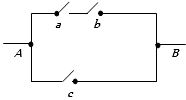
Consider the circuit,If the probability that each switch is closed is $p$, then find the probability of current flowing through $AB$