MCQ
The value of Reynolds number for a narrow tube is:
  • A
    10
  • B
    100
  • 1000
  • D
    10000

Answer

Correct option: C.
1000
C

Need a full question paper?

Generate a complete, print-ready paper with questions like this in minutes — across 16+ boards, with answer keys.
Start Generating Free

Similar questions

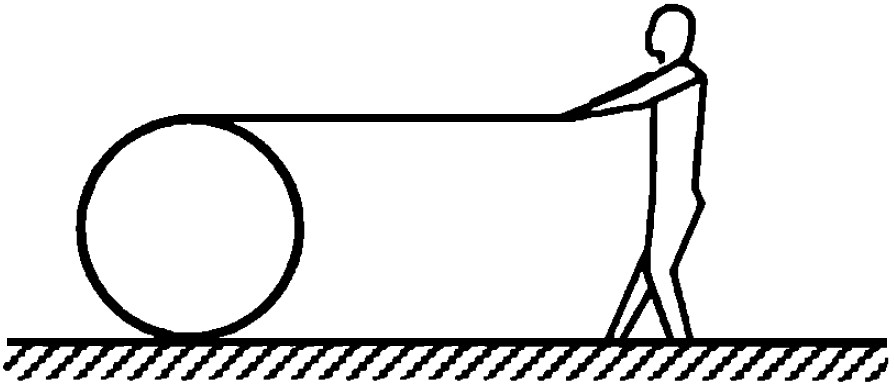
A string of negligible thickness is wrapped several times around a cylinder kept on a rough horizontal surface. A man standing at a distance $1$ from the cylinder holds one end of the string and pulls the cylinder towards him. There is no slipping anywhere. The length of the string passed through the hand of the man while the cylinder reaches his hands is:
A body of mass $2\, kg$ travels according to law $x = at + bt^2 + ct^3$, where $a = 3\, m/s$, $b = 4\,m/s^2$ and $c = 5\, m/s^3$, then force acting on body at $t = 2\, s$  ......... $N$.
A particle performs simple harmonic motion with amplitude $A$. Its speed is trebled at the instant that it is at a distance $\frac{{2A}}{3}$ from equilibrium position. The new amplitude of the motion is
Which of the following most closely depicts the correct variation of the gravitational potential $V(r)$ due to a large planet of radius $R$ and uniform mass density ? (figures are not drawn to scale)
The average energy associated with each translational degree of freedom is:
Two particles are executing simple harmonic motion of the same amplitude $A$ and frequency $\omega$ along the $x-$axis. Their mean position is separated by distance $X_0(X_0 > A).$ If the maximum separation between them is $(X_0 + A)$, the phase difference between their motion is:
Gauge pressure ........
A cylinder is rolling down on an inclined plane of inclination $60^{\circ}$. It's acceleration during rolling down will be $\frac{\mathrm{x}}{\sqrt{3}} \mathrm{~m} / \mathrm{s}^2$, where $\mathrm{x}=$___________. (use $\mathrm{g}=10 \mathrm{~m} / \mathrm{s}^2$ ).
A free body of mass $8\, kg$ is travelling at $2\, meter$ per second in a straight line. At a certain instant, the body splits into two equal parts due to internal explosion which releases $16 \,joules$ of energy. Neither part leaves the original line of motion finally
A thermometer graduated according to a linear scale reads a value $x_0$ when in contact with boiling water, and $x_0/3$ when in contact with ice. What is the temperature of an object in ${}^oC$, if this thermometer in the contact with the object reads $x_0/2$ ?