MCQ
The value of $\sqrt{5+2\sqrt6},$ is:
  • A
    $\sqrt3-\sqrt2$
  • B
    $\sqrt3+\sqrt2$
  • C
    $\sqrt5+\sqrt6$
  • D
    None of these

Answer

  1. $\sqrt3+\sqrt2$
    Solution:
    $\sqrt{5+2\sqrt6}$
    $=\sqrt{3+2+2\big(\sqrt3\big)\big(\sqrt2\big)}$
    $=\sqrt{\big(\sqrt3\big)^2+\big(\sqrt2\big)^2-2\big(\sqrt3\big)\big(\sqrt2\big)}$
    $=\sqrt{\big(\sqrt2+\sqrt2\big)^2}$
    $=\sqrt3+\sqrt2$
    Hence, correct option is (b).

Need a full question paper?

Generate a complete, print-ready paper with questions like this in minutes — across 16+ boards, with answer keys.

Start Generating Free

Similar questions

The value of $7^{\frac{1}{2}}.8^{\frac{1}{2}}$ is:
If x51 + 51 is divided by x + 1, then the remainder is:
The lengths of a triangle are 6cm, 8cm and 10cm. Then the length of perpendicular from the opposite vertex to the side whose length is 8cm is:
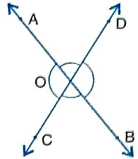
In Fig , $A B$ and $C D$ are two lines intersecting at point $O$. Which one of the following statements is false?
(a) $\angle A O C$ and $\angle B O D$ are adjacent angles
(b) $\angle A O C$ and $\angle C O B$ form a linear pair
(c) $\angle A O D$ and $\angle D O B$ are supplementary angles
(d) $\angle C O B$ and $\angle A O D$ is a pair of vertically opposite angles
Image
If each edge of cuboid of surface area S is doubled, then surface area of the new cuboid is:
  1. 2S
  2. 4S
  3. 6S
  4. 8S
If APB and CQD are two parallel lines, then the bisectors of the angles APQ, BPQ, CQP and PQD form.
The area of a rhombus is 96cm2. If one of its diagonals is 16cm, then the length of its side is:
Three Statements are given below:
  1. In a, Parallelogram the angle bisectors of 2 adjacent angles enclose a right angle.
  2. The angle bisector of a Parallelogram form a Rectangle.
  3. The Triangle formed by joining the mid-points of the sides of an isosceles triangle is not necessarily an isosceles triangle.
    Which of the statement/ statements is/ are True?
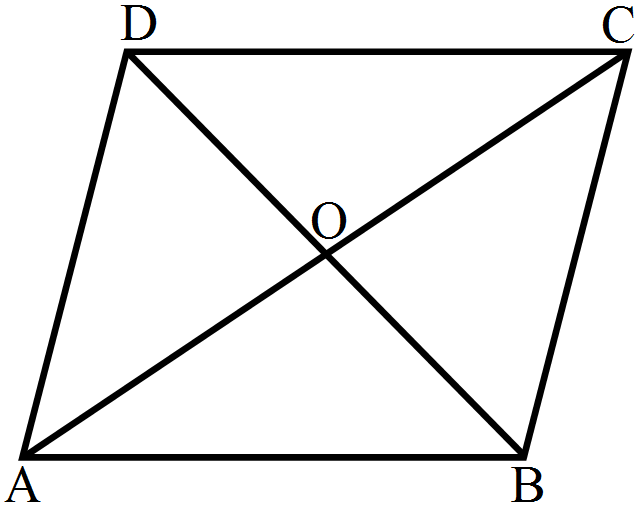
In the given figure, ABCD is a ||gm in which diagonals AC and BD intersect at O. If ar(||gm ABCD) is 52cm2, then the $\text{ar}(\triangle\text{AOB})=?$

  1. 26cm2
  2. 18.5cm2
  3. 39cm2
  4. 13cm2