MCQ
The value of the determinant $\begin{vmatrix}\text{x}&\text{x}+\text{y}&\text{x}+2\text{y}\\\text{x}+2\text{y}&\text{x}&\text{x}+\text{y}\\\text{x}+\text{y}&\text{x}+2\text{y}&\text{x}\end{vmatrix}$ is:
  • A
    $9x^2(x + y)$
  • $9y^2(x + y)$
  • C
    $3y^2(x + y)$
  • D
    $7x^2(x + y)$

Answer

Correct option: B.
$9y^2(x + y)$
$\begin{vmatrix}\text{x}&\text{x}+\text{y}&\text{x}+2\text{y}\\\text{x}+2\text{y}&\text{x}&\text{x}+\text{y}\\\text{x}+\text{y}&\text{x}+2\text{y}&\text{x}\end{vmatrix}$
$=\begin{vmatrix}-2\text{y}&\text{y}&\text{y}\\\text{x}+2\text{y}&\text{x}&\text{x}+\text{y}\\-\text{y}&2\text{y}&-\text{y}\end{vmatrix} [$Applying $R_1 \rightarrow R_1 - R_2$ and $R_3\rightarrow R_3 - R_2$]
$=\text{y}^2\begin{vmatrix}-2&1&1\\\text{x}+2\text{y}&\text{x}&\text{x}+\text{y}\\-1&2&-1\end{vmatrix} [$Taking $(y)$ common from $R_1$ and from $R_3]$
$=\text{y}^2\begin{vmatrix}-2&-3&3\\\text{x}+2\text{y}&3\text{x}+4\text{y}&-\text{y}\\-1&0&0\end{vmatrix} [$Applying $C_2 \rightarrow C_2 + 2C_1$ and $C_3 \rightarrow C_3 - C_1]$
$=\text{y}^2\big[-1(3\text{y}-9\text{x}-12\text{y})\big]$
$=\text{y}^2[9\text{y}+9\text{x}]$
$=9\text{y}^2(\text{y}+\text{x})$
Hence, the correct option is $(b)$

Need a full question paper?

Generate a complete, print-ready paper with questions like this in minutes — across 16+ boards, with answer keys.

Start Generating Free

Similar questions

Suppose that $h (x) = f (x)·g(x)$ and $F(x) ={\rm{f}}\,\left( {{\rm{g}}(x)} \right)$, where $f (2) = 3 ; g(2) = 5 ; g'(2) = 4 ;$ $f '(2) = -2$ and $f '(5) = 11$, then
Let a vector $\vec{a}$ be coplanar with vectors $\vec{b}=2 \hat{i}+\hat{j}+\hat{k}$ and $\vec{c}=\hat{i}-\hat{j}+\hat{k} .$ If $\vec{a}$ is perpendicular to $\vec{d}=3 \vec{i}+2 \hat{j}+6 \hat{k}$, and $|\vec{a}|=\sqrt{10} .$ Then a possible value of $[\overrightarrow{\mathrm{a}} \overrightarrow{\mathrm{b}} \overrightarrow{\mathrm{c}}]+[\overrightarrow{\mathrm{a}} \overrightarrow{\mathrm{b}} \vec{d}]+[\overrightarrow{\mathrm{a}} \vec{c} \vec{d}]$ is equal to:
A farmer $F _1$ has a land in the shape of a triangle with vertices at $P (0,0), Q (1,1)$ and $R (2$, $0)$. From this land, a neighbouring farmer $F_2$ takes away the region which lies between the side $PQ$ and a curve of the form $y = x ^{ n }( n >1)$. If the area of the region taken away by the farmer $F_2$ by the farmer $F_2$ is eaxtly $30 \%$ of the area of $\triangle P Q R$, then the value of $n$ is. . . . . .
The order of the differential whose general solution is given by ${\text{y}}=\text{C}_1\cos(2\text{x}+\text{C}_{2})+(\text{C}_{3}+\text{C}_{4})\text{a}^{\text{x}+\text{C}_{5}}+\text{C}_{6}\sin(\text{x}-\text{C}_{7}).$
In order that the matrix $\left[ {\begin{array}{*{20}{c}}1&2&3\\4&5&6\\3&\lambda &5\end{array}} \right]$ be non-singular, $\lambda $ should not be equal to
If $p = i - 2j + 3k$ and $q = 3i + j + 2k,$ then a vector along r which is linear combination of $ p$ and  $ q$  and also perpendicular to  $ q$ is
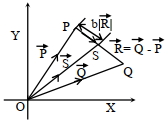
Three vectors $\vec{P}, \vec{Q}$ and $\vec{R}$ are shown in the figure. Let $S$ be any point on the vector $\vec{R}$. The distance between the point $P$ ad $S$ is $b|\vec{R}|$. The general relation among vectors $\vec{P}, \vec{Q}$ and $\vec{S}$ is
If $(a+\sqrt{2} b \cos x)(a-\sqrt{2} b \cos y)=a^{2}-b^{2}$ where $a>b>0,$ then $\frac{d x}{d y}$ at $\left(\frac{\pi}{4}, \frac{\pi}{4}\right)$ is
Objective function of a LPP is:
Let $[x]$ denote the greatest integer less than or equal to $x.$ If $f(x) = \sin^{-1}x, g(x) = [x^2]$ and $\text{h(x)}=2\text{x},\frac{1}{2}\leq\text{x}\leq\frac{1}{\sqrt{2}},$ then