MCQ
The variance of first $50$ even natural numbers is
  • A
    $437$
  • B
    $\frac{{437}}{4}$
  • C
    $\frac{{833}}{4}$
  • $833$

Answer

Correct option: D.
$833$
d
$2,4,6,8,......,98,100$

${\sigma ^2} = \frac{{\sum x_1^2}}{n} - {\left( {\overline {.x} } \right)^2}$

$\frac{{{2^2} + {4^2} + {6^2} + .... + {{100}^2}}}{{50}}$$ - {\left( {\frac{{2 + 4 + 6 + .... + 100}}{{50}}} \right)^2}$

${i_1} = \frac{{{2^2} + {4^2} + {6^2} + .... + {{100}^2}}}{{50}}$

$ = {2^2}\frac{{{1^2} + {2^2} + {3^2} + ... + {{50}^2}}}{{50}}$

$ = \frac{{{2^2}}}{{50}} \times 50\left( {50 + 1} \right)\left( {100 + 1} \right)$

$ = 3434$

${i_2} = {\left( {\frac{{2 + 4 + 6 + ..... + 100}}{{50}}} \right)^2}$

$ = {\left( {\frac{{50 \times \frac{{2 + 100}}{2}}}{{50}}} \right)^2}$

$ = {\left( {51} \right)^2}$

${\sigma ^2} = 3434 - 2661 = 833$

Need a full question paper?

Generate a complete, print-ready paper with questions like this in minutes — across 16+ boards, with answer keys.

Start Generating Free

Similar questions

Integral curve satisfying $y' = \frac{{{x^2} + {y^2}}}{{{x^2} - {y^2}}},\;y(1) = 2$ has the slope at the point $(1, 0)$ of the curve, equal to
The order and degree of the differential equation $(\frac{d^3y}{dx^3}+y\frac{dy}{dx})^{\frac{7}{5}} =x^3\frac{d^2y}{dx^2}$ are $m$ and $n$ respectively, then $(m + n)$ is equal to-
If $\alpha, \beta \in R$ are such that $1-2 i$ (here $i ^{2}=-1$ ) is a root of $z^{2}+\alpha z+\beta=0,$ then $(\alpha-\beta)$ is equal to ..... .
Two persons $A$ and $B$ take turns in throwing a pair of dice. The first person to through $9$ from both dice will be avoided the prize. If $A$ throws first then the probability that $B$ wins the game is
For how many value $(s)$ of $x$ in the closed interval $[ - 4,\,\, - 1]$ is the matrix $\left[ {\begin{array}{*{20}{c}}3&{ - 1 + x}&2\\3&{ - 1}&{x + 2}\\{x + 3}&{ - 1}&2\end{array}} \right]$  singular
If $\frac{{z - \alpha }}{{z + \alpha }}\left( {\alpha  \in R} \right)$ is a purely imaginary number and $\left| z \right| = 2$, then a value of $\alpha $ is
If a continuous $f$ defined on the real line $R$, assumes positive and negative values in $R$ then the equation $f(x)=0$ has a root in $R$. For example, if it is known that a continuous function $f$ on $R$ is positive at some point and its minimum values is negative then the equation $f(x)=0$ has a root in $R$.

Consider $f(x)=k e^x-x$ for all real $x$ where $k$ is a real constant.

$1.$  The line $\mathrm{y}=\mathrm{x}$ meets $\mathrm{y}=k e^{\mathrm{x}}$ for $\mathrm{k} \leq 0$ at

$(A)$ no point $(B)$ one point

$(C)$ two points $(D)$ more than two points

$2.$  The positive value of $\mathrm{k}$ for which $\mathrm{ke}^{\mathrm{x}}-\mathrm{x}=0$ has only one root is

$(A)$ $1 / \mathrm{e}$ $(B)$ $1$ $(C)$ e $(D)$ $\log _e 2$

$3.$  For $k>0$, the set of all values of $k$ for which $k e^x-x=0$ has two distinct roots is

$(A)$ $\left(0, \frac{1}{\mathrm{e}}\right)$ $(B)$ $\left(\frac{1}{\mathrm{e}}, 1\right)$ $(C)$ $\left(\frac{1}{e}, \infty\right)$ $(D)$ $(0,1)$

Give the answer question $1,2$ and $3.$
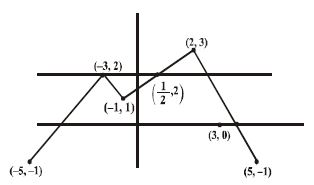
The equation $ lm\,\left( {\frac{{iz - 2}}{{z - i}}} \right) + 1 = 0\,,z \in C\,,z \ne i$ represents a part of a circle having radius equal to
Let ${T_n}$ denote the number of triangles which can be formed using the vertices of a regular polygon of $n$ sides. If ${T_{n + 1}} - {T_n} = 21,$ then $n$ equals
The graph of $y = f(x)$ is shown then number of solutions of the equation $f(f(x)) =2$ is